The abrupt announcement of the closure of My Mistress Cafe in Clayfield surprised loyal patrons. Speculation swirled among the community after its owners, Natalie Vostok and Rhiannon Redmond, shuttered the popular cafe’s doors without notice.
On Thursday, 22, Feb 2024, an air of uncertainty loomed as customers arrived at the cafe only to find the establishment inaccessible.
Well-loved for its delectable fare, My Mistress Cafe boasts a substantial social media following. However, there were no indications that the site had closed, prompting concern and confusion among its dedicated clientele.
Despite the sombre atmosphere surrounding My Mistress café, a glimmer of hope emerged on Friday, 23 Feb 2024, with the appearance of a mysterious message in the café’s window.
Photo Credit: Google Maps
Alongside the customary “Sorry, we are closed” notice, a new message written in bold red ink captured the attention of passersby.
“The door has not closed. In fact, it has now opened to new possibilities,” the cryptic message declared, hinting at a potential shift in the café’s future direction.
Despite repeated attempts, the owners have remained elusive, leaving patrons and observers eager for further insight into the unfolding narrative of the café’s next chapters.
Health authorities are sounding the alarm over a looming surge in Ross River virus infections, a concerning mosquito-borne illness. The rising number of infections has prompted mosquito spraying initiatives in high-risk suburbs, such as Wooloowin, Clayfield, Gordon Park, and Hendra in the northern suburbs of Brisbane, among other areas.
Chief Health Officer John Gerrard revealed a very high number of Ross River virus detections in mosquitoes across nine different council areas stretching from Mackay to South East Queensland.
And the number of infected mosquitoes — at 31 positive traps of the 700 tested across the state — is higher than what was detected during the horror 2019-2020 summer, ultimately leading to a whopping 3381 Ross River infections for that year.
There were 699 cases of the Ross River virus in 2023. As of the end of January this year, 64 people have been infected.
Efforts to increased mosquito spraying are underway in Wooloowin and other North Brisbane areas.
About the Ross River Virus
There is no cure nor vaccine for Ross River virus, and whilst most people recover in a few weeks some people experience joint pain and fatigue months after infection.
Origin and Spread
Ross River Virus (RRV) is a mosquito-borne alphavirus that is endemic to Australia, Papua New Guinea, and the Pacific Islands. The virus primarily spreads through the bite of infected mosquitoes, notably those in the Aedes and Culex genera, which are common in these regions.
Symptoms and Treatment
RRV infection can lead to a range of symptoms, from mild to debilitating. Common symptoms include polyarthritis, rash, fever, fatigue, and muscle pain. These symptoms can significantly affect an individual’s ability to perform daily activities and, in some cases, can persist for months or even years. While there is no specific treatment for RRV, management of symptoms is possible through medication and physical therapy.
Epidemiology
The virus has shown a notable propensity for causing large outbreaks, particularly in coastal regions. The incidence of RRV infection varies seasonally and geographically, with the highest rates typically observed in areas with warmer climates and in proximity to bodies of water where mosquito populations thrive.
Prevention
Preventing RRV infection centres on controlling mosquito populations and minimising individual exposure to mosquito bites. Public health measures include community education on the use of insect repellent, the importance of wearing protective clothing, and the need to eliminate standing water around homes and communities to reduce mosquito breeding sites.
Global Health Perspective
RRV is considered a significant public health issue within its endemic regions. With climate change and increasing global travel, there is a potential for RRV to expand its geographical reach, making it a subject of interest for global health monitoring and research
Photo Credit: Unsplash
Elevated Risk and Intensified Efforts
Dr Gerrard expressed concern over the significant increase in Ross River virus detections in mosquito populations early in the usual season, particularly across a wide geographical area. This surge indicates heightened virus activity.
Typically, Ross River virus infections begin to surge with the arrival of rain and warm temperatures in December, reaching their peak in February and March. Moreover, it’s common to observe a notable increase in Ross River virus cases every three to four years, indicating a potential spike in infections.
With the current high mosquito numbers and recent surveillance findings, there is an increased risk of human exposure to mosquitoes carrying the virus throughout Queensland.
Metro North Public Health Unit entomologist Jon Darbro said in the past month it had been either wet or hot which added to the extra mosquitoes around.
Mr Darbro explained that the increased rainfall this season provides mosquitoes with additional breeding sites for laying eggs and larval development, resulting in larger mosquito populations. Warmer temperatures also contribute to heightened mosquito activity, accelerating their growth and the drying process of eggs. These conditions create an ideal environment for multiple mosquito species to thrive, as observed by many.
Metro North covers areas like Wooloowin, Clayfield and Hendra, which has intensified its spraying efforts in late January 2024.
More Mosquito Spraying for Brisbane and Gold Coast
Swarms of mosquitoes have inundated nearly every suburb across South East Queensland, with wet weather and warm temperatures creating the perfect breeding grounds for the flying pests. The unwanted buzz and bites have forced Brisbane City Council to spray an extraordinary 2,400 sites a week – a 140 per cent increase on the normal mozzie spraying schedules including seven aerial attacks in the past nine weeks.
Across Brisbane, 136 of 190 suburbs have been targeted and 24 on the Gold Coast. Redland City Council have increased their aerial treatments of mosquito larvae by 60 per cent making it the biggest year on record since 2016-2017. While Logan City Council, Sunshine Coast Council and Gold Coast Coast have also increased their spraying schedules.
According to the Queensland Health notifiable notifications data, dozens of mosquito-borne disease cases have been confirmed, including 29 cases of Ross River virus and three of dengue in the first three weeks of January.
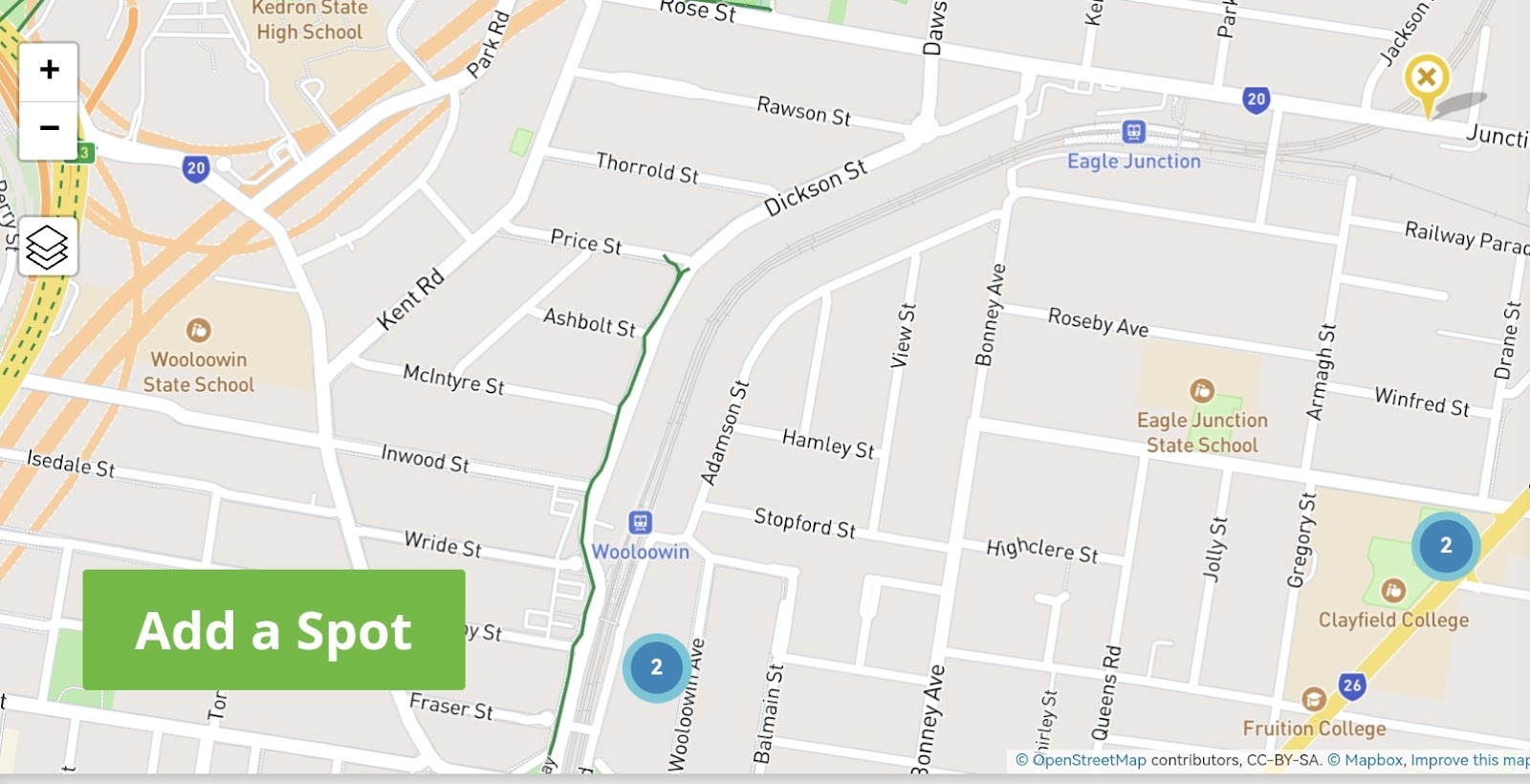
Dickson Street in Wooloowin has been identified as one of the 10 most dangerous spots in Brisbane for cyclists, according to newly released data from the cycling safety app BikeSpot.
BikeSpot’s 2023 Interim Safety Report, released last week, ranked Dickson Street as the number 3 unsafe area for Brisbane cyclists due to a lack of bike lanes and a missing link with the North Brisbane Bikeway.
One BikeSpot user reported that riding south on Dickson Street was the “most dangerous section they have rode so far” because the North Brisbane Bikeway abruptly ends at Price Street, leaving cyclists to traverse Dickson Street without a bike lane.
Photo credit: BikeSpot map
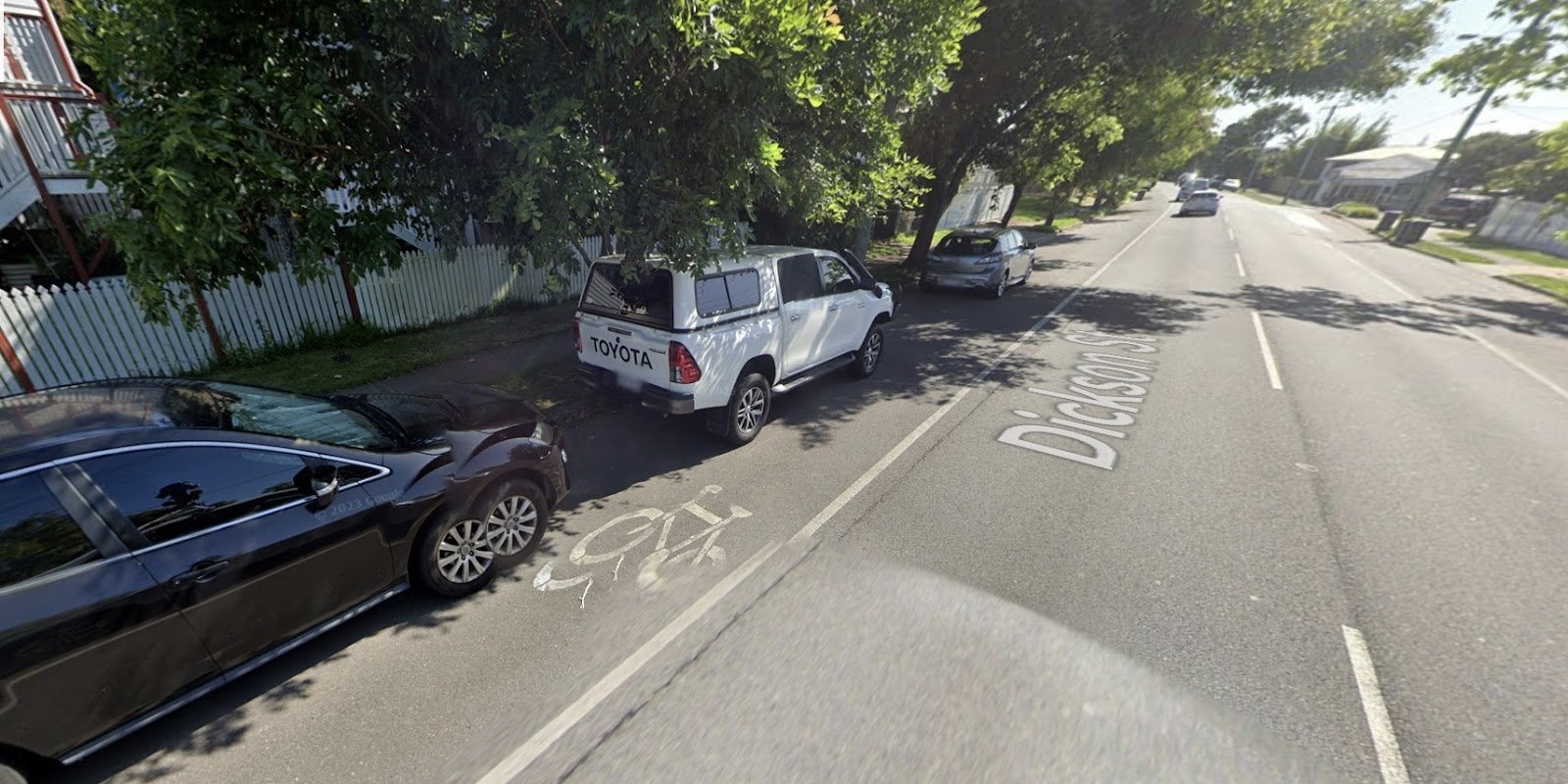
“Bike lane ends, forcing bikes onto road or path,” one cyclist said. Others commented that there are lots of parked cars on the street.
Other cyclists agreed, saying the short section of the North Brisbane Bikeway is incomplete and leaves them feeling vulnerable when transitioning to Dickson Street.
Photo credit: Google Street View
Cancelled Project
The Brisbane City Council has announced the cancellation of several key cycling infrastructure projects, including the North Brisbane Bikeway extension, due to the devastating floods in South East Queensland in February 2022.
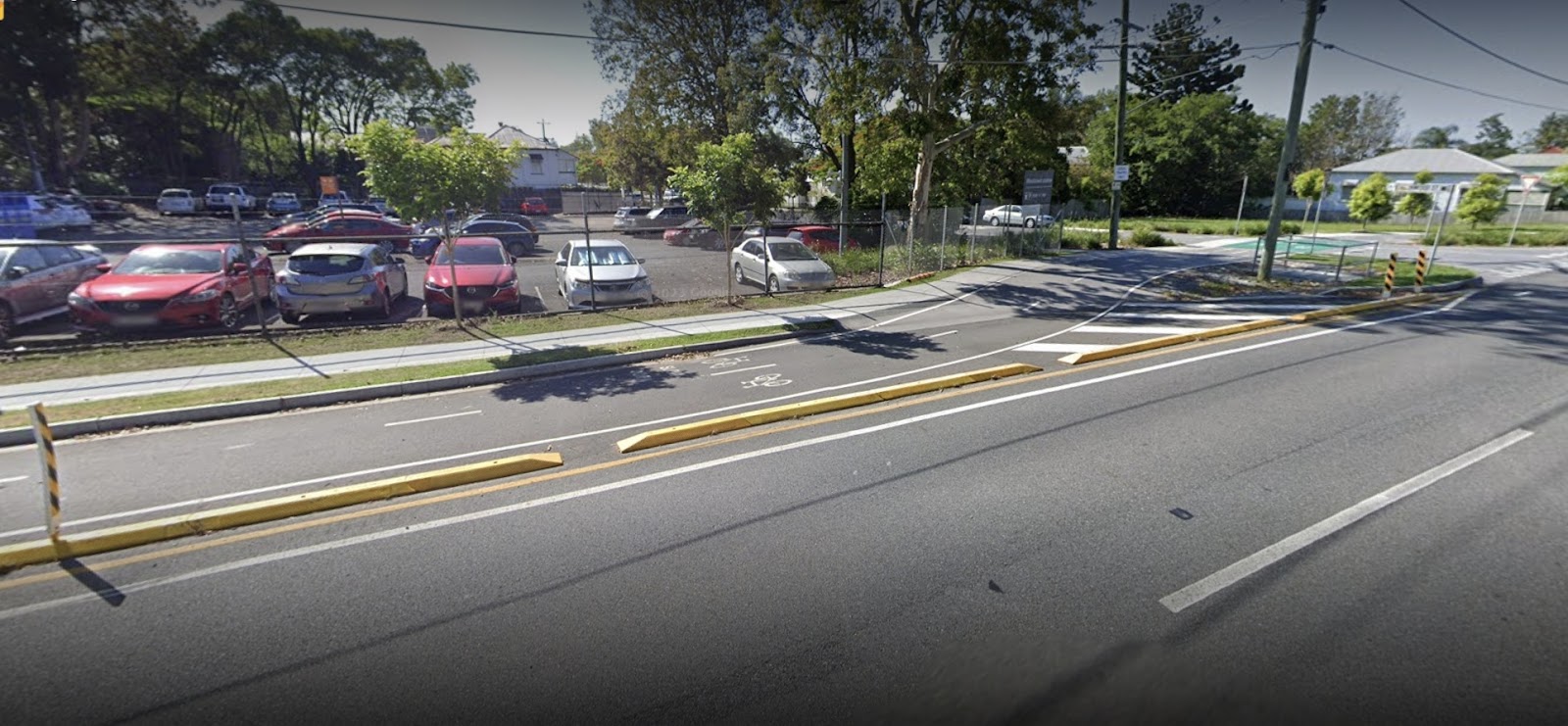
According to the council’s website, proposed plans to create a dedicated and separated bikeway along Dickson Street and Bonney Avenue, connecting stage four of the North Brisbane Bikeway to Junction Road, will no longer go ahead.
Funding has also been pulled from a project to build a “green street” with shared, low-speed active travel routes for cyclists and pedestrians along Keith Street, Sydney Street and Jackson Street.
Photo credit: Google Street View
The council said it made the difficult decision to redirect resources and prioritise the rebuilding and repair of roads, bridges, existing bikeways, parks and sports facilities across Brisbane that were damaged by February 2022’s catastrophic flooding.
“While the proposed project is not proceeding, Council is committed to working with the Department of Transport and Main Roads on the broader North Brisbane Bikeway network and future active transport connections in this area,” Council stated.
Cycling advocacy groups have expressed disappointment over the cancellations, saying the projects would have greatly improved safety and connectivity for Brisbane cyclists. However, the repairs from the destructive floods have been deemed a priority by local officials.
Students from Clayfield College, Brisbane Boys’ College, Somerville House, and Sunshine Coast Grammar School are poised to experience a unique blend of leadership and teamwork development at a newly acquired rural retreat in the Scenic Rim.
The Presbyterian and Methodist Schools Association (PMSA), which governs these four prominent South East Queensland schools, has recently purchased a significant property near Lake Moogerah.
This acquisition represents a strategic shift from the previously planned Outdoor Learning Campus at Mount Moon, as the PMSA seeks to provide more diverse and enriching educational experiences for its students.
Embracing Nature and Leadership
Located in the serene backdrop of Lake Moogerah, the new retreat promises a host of outdoor activities designed to foster practical and active learning.
The PMSA envisions this space as not just a site for physical activity but as a hub where students can connect with nature and each other, away from the distractions of technology.
This aligns with their broader objective of holistic student development, emphasizing Christian values and behavioural characteristics such as resilience, confidence, and leadership.
The PMSA’s decision to acquire this new property was driven by a desire to enhance and enrich the educational opportunities available to students and their families.
“Through this purchase, we will now have our own dedicated outdoor education facility that will support the delivery of a PMSA outdoor education experience,” PMSA Board Chair, Margaret Berry said.
This vision extends beyond the PMSA schools, as the facility will also be available to other schools and private groups after the completion of building works.
Building Towards the Future
Under the guidance of the PMSA, the new retreat will undergo refurbishment and remodeling to become a state-of-the-art outdoor education center.
Expected to be operational by 2025, it will serve as a dynamic environment for students to learn, adapt to changes, work collaboratively, and become better versions of themselves.
“Camp Moogerah gives us the capacity to operate a purpose-built facility that will enable us to facilitate a robust and comprehensive outdoor education program to meet the holistic needs of our students and support the long term needs of schools,” PMSA Chief Executive Officer, Shane Coppin said.
The PMSA schools regularly engage in a range of collaborative activities, from Christian fellowship to debating, sports, and leadership programs. These activities, now further supported by the new retreat, underscore the association’s commitment to building caring school communities and delivering exceptional education.
Here’s the scoop for all you festive fanatics and Christmas cheer chasers: St Mark’s Clayfield is running a Christmas Tree Festival, and guess what? You’re invited!
Mark your calendars for 25 Nov 2023, because from noon until the stars come out at 7:00 p.m., it’s going to be a holly jolly hullabaloo.
Tree-mendous Displays and Market Madness
First up, prepare to gawk at Christmas trees that are more dressed up than a penguin in a tuxedo. These aren’t your average, everyday festive firs; we’re talking about a forest of fabulously fanciful trees that’ll have your eyes popping.
And for those of you who love a good rummage, there’s a market that’s more packed than Santa’s sack. Local artisans are bringing their A-game with gifts and crafts so unique, even the elves would be jealous.
High Tea and Carol Capers
Feeling peckish? St Mark’s has got you covered with a high tea that’s so fancy, you might start speaking in Shakespearean English. Pinkies up, folks! And for the carol enthusiasts, warm up those vocal cords because there’s going to be carol singing. It’s the perfect chance to show off those shower-singing skills in public.
Sausage Sizzle and a Light Spectacle
What’s a party without food? There’s a free sausage sizzle, and let’s be honest, who doesn’t love free food? These sausages are hot off the grill and ready to jump into your belly. As the evening draws in, prepare for the grand finale – the Christmas lights turning on. It’s like an early New Year’s Eve spectacle but with less ‘bang’ and more ‘twinkle.’
Join the Festive Frenzy!
So, Clayfield folks and nearby dwellers, don’t be a Scrooge and miss out on this festive fiesta. It’s a chance to kick off the holiday season with a bang, or at least with a lot of twinkling lights and a belly full of tea and sausages.
In the lush neighbourhood of Clayfield, there’s a special house designed by the talented architects from Richards and Spence, known for their work on hotels and shops, such as The Calile Hotel in the inner city.
Whilst they’re usually famous for that, this two-story house at 8 Milne Street in Clayfield is a rare discovery. It was finished in 2011 and was the very first standalone home project for this architect duo.
Breaking the Rules
What sets this house apart is that it doesn’t follow the usual rules for home designs. Instead of having a regular front and back yard, the architects decided to make the most of the narrow plot by pushing the house design “to the edges” along the boundaries. This way, they created a big outdoor space in the middle of the house.
The main living areas, like the kitchen, living room, and dining space, all look out onto a spacious courtyard with a pool. This not only keeps the nosy neighbours at bay but also lets natural light and fresh air flood into the house.
The inside of the house is all about simple and modern design. They used light-coloured concrete blocks and stonework for the interiors, giving it a sleek look. But they used traditional timber and tin for the outside, just like old Queensland houses. This way, they followed the local rules while making a bold and unique statement.
Inside, there’s a big central hallway with high walls made of those concrete blocks. This creates open spaces over the living and media rooms, and there are four bedrooms and a lounge upstairs.
The Power of Concrete and Stone
Instead of going for a lightweight timber and tin house, which is more common in hot climates, the architects found inspiration in a Danish architect’s house made from local limestone. They wanted to make the house look like a bit of a ruin.
They even put the window frames on the outside of the walls, so it’s hard to see them. This idea has been used in their other famous projects like The Calile Hotel and La Scala.
“This house is really special in Queensland’s world of architecture. Richards and Spence are famous not just locally but all around the world. Owning this house is a fantastic chance,” real estate agent Heath Williams from Place Estate Agents New Farm said.
So, this Clayfield house is like a hidden treasure for architecture lovers. It shows how talented architects can make a unique and amazing place to live. If you’re into architecture and want a one-of-a-kind home in Clayfield, you should check it out.
The three-bedroom, three-bathroom townhouse has high-end finishes such as stone countertops and soft-close cabinets that add to its modern, executive style. It also features spacious indoor and outdoor living spaces, a multi-purpose room and a large balcony.
The townhouse is within walking distance of Harris Farm Markets and is located in the sought-after suburb of Clayfield, close to Brisbane’s CBD.
The transaction highlights the strong demand for townhouses in Brisbane, which agents say are popular because of their relative affordability compared to houses.
Broncos rising star Kobe Hetherington
The purchase follows Hetherington’s appearance with the Brisbane Broncos against the Penrith Panthers in this year’s NRL Grand Final. Although the Panthers won the match 26-24 to complete their three-peat, Hetherington’s new townhouse gives him a cause for celebration.
With more than 50 NRL games under his belt, Kobe Hetherington is one to watch for the Broncos faithful. The son of former Australia and Queensland representative Jason Hetherington, Kobe won the Broncos Rookie of the Year award back in 2021.
How did you learn your times tables? Many adults today, recall having learnt all of them ‘off by heart’, through rote memorization, but there is a strong argument to support that a more ‘meaningful’ approach will have greater long-term benefits.
Rote learning is simply a way for the brain to store data short-term and does not require a deep understanding of a concept. In order to commit all 144 times tables to long-term memory, they must be accessed, repeated, and tested frequently.
What we have learnt over the years, is that learning in meaningful ways, is far more effective.
At NumberWorks’nWords, we know that true mastery of a concept (the times tables in this instance), requires a higher order thinking, which in turn leads to the formation of new neural pathways. The brain’s ability to make connections in this way is referred to as neuroplasticity.
A highly effective approach to the teaching of mathematics is called Cognitive Guided Instruction (CGI). Like Bloom’s Taxomony (Benjamin Bloom 1956), it focuses on ‘conceptual understanding’ over ‘process’ and suggests learning without understanding, limits a child’s ability to problem solve and apply what they have learnt to new situations.
So let’s return to the task of learning the
Times Tables and explain how, at NumberWorks’nWords, we do this in a more
meaningful way.
Our program incorporates a range of strategies when learning the times tables, so children are afforded the opportunities to make connections in their understanding of number and number properties, patterns, place value, operations and more.
Our comprehensive visual and interactive resources, used in
conjunction with concrete materials, written representations and most
importantly, explicit teaching, empower our students to make connections
in real and relevant ways.
When something ’clicks’ for a child, it is like it is locked in.
Suddenly, the steps make sense and the new piece of information is
literally attached or connected to something permanent in the brain.
Recalling and using this information becomes fluid and purposeful,
and enables the child to understand the concept, rather than simply
following a process that has no meaning.
When teaching the Times Tables, we always start with the easiest patterns (x1, x2, x10, x5) then move onto the progressively more difficult (x3, x4, x9, x11, x6, x7, x8, x12). The accepted standard of fluid recall is to be able to solve each table in 3 seconds or less.
Below are some strategies that you may find
helpful, as your child masters each of the times tables.
1X
The number always stays the same. Explaining this as ‘one group of’
something, helps the child to see that there is a conservation of number
and that the ‘one group’ does not change.
2X
Some children may not initially see that the 2 times table is the
same as the addition doubles strategy. Once this connection is made, the
2x process is often understood in a different perspective and it alters
the way the brain arranges the numbers.
Using visualisation also helps, eg 2×3 or 2 groups of 3 is like an
insect’s legs (3 on each side), 2×4 is a spider’s legs, 2×6 is a carton
of 12 eggs in 2 rows.
3X
Children learn to skip count in 3s and also learn an addition
strategy called ‘count on’ which means you put the large number in your
head and count on up to 3 steps forward, eg if you know 3×3 =9, then
4×3= 9 count on 3 more, hence 9 (big number in your head) count on
10…11…12 (the answer).
4X
Once a child masters the 2X tables, then the 4X is simply double the
2X. eg. 2×7=14, so 4×7= double 14 which is 28. This is particularly easy
when there is no need to bridge the tens.
If the child does need to bridge the tens, the connection to place
value and partitioning become important eg 2×8 can be considered as
5+3+5+3 which the child could then put the ‘friendly’ numbers together
and mentally arrange them as 5+5+3+3 = 10+6.
5X
Children learn to skip count in 5s orally because they can quickly learn the pattern of the words. Reciting the pattern is actually a quick and efficient way to get an answer to a 5X table, so this is an easy connection for children to make.
Photo Credit: Pexels/
X6, X7, and X8
I group these together because it allows children to see that they
are not as difficult as they may have first thought. Once the child
masters the earlier tables (x1, x2, x3, x4, x5, x9, x10, x11), it means
they can turn them all around to solve any table that includes a 6, a 7
or an 8.
Making this connection straight away, means children will more
readily apply the learnt strategy, now in a meaningful way to the more
‘difficult’ tables.
I often explain to students who are learning their tables with us,
that there is a useful strategy, or pattern to almost all of them.
However, there is a small list of specific tables that I recommend
they do commit to memory. When children realise that the list is so
small, it makes the overwhelming task of learning (memorising) ‘all’ of
the tables, seem very easy indeed.
6×6=36
6×7=42
6×8=48
7×7=49
7×8=56
8×8=64
9X
Not everyone is aware of the many strategies and patterns that exist
in the 9 time tables. Firstly, the 2 digit answers in every instance
(1-10) always appear as the same combinations of digits ie 2 and 7 go
together to make 3×9=27 as well as 8×9=72, 3and 6 go together as 36 and
63 etc. The added clue is that the 2 digit combinations actually add to
make 9, so this helps the child to remember which ones go together.
When presented with a 9 times table, eg 9×8 the child can think that
10 x 8 would be 80, so 9×8 will start with a 7 and the number that goes
together with 7 is 2. The answer is 72.
Then of course there is always the ‘using the fingers’ strategy. By
counting off the 10 fingers 1 to 10, simply curl over the finger
represented in the 9x fact. (See image below)
10X
It is important for children to understand why the zero goes on the
end of any number that is being multiplied by 10. The pattern of simply
‘adding’ a zero is easy, but again the risk is that children will simply
follow a process without really attaching any meaning to it. Using
language like ‘adding’ can actually confuse many children with the
process of addition and of course that is not what is happening here.
When children make the connection to the changing place value of the
digits, they will realise that the original number is now 10 times
bigger! When learning to multiply by ten, children need opportunities to
manipulate and arrange concrete materials and to see the process
visually, before they can understand what is happening.
The learning of concepts such as fractions, decimals will be so much
easier once children have this fundamental understanding of the 10 times
tables.
Photo Credit: Pexels/August de Richelieu
11X
The obvious pattern in the repeated digit makes the 11s easy to
recall, but again, it is important to develop this understanding through
cognitive guided instruction (so the child knows the answer is the
combination of the already learnt 10x fact plus the 1x fact)
12X
Like the 11s, the 12 times tables are the combination of the already learnt 10x fact and 2x fact.
At NumberWorks’nWords we know that mastery of the Times Tables is a fundamental core skill. We focus on core skills and the teaching of meaningful strategies, because it is proven that the more connections children make as they learn each table, the more readily they will be able to apply their understanding to each new mathematical problem in the future.
This competition is proudly sponsored by NumberWorksnWords in Clayfield. Every entrant will receive a free evaluation and a free lesson. All entrants will go into a draw, the winner will receive a whole term’s tuition, worth $650.
TO ENTER: Simply pass the problem below onto your child and ask them to solve it. Then complete the entry form below it. Competition closes on October 17, 2023.
Did you know that the first two owners of Stanley Hall in Clayfied had untimely deaths in the family at the estate, until one succeeding owner brought his Melbourne Cup-winning luck to the place and broke the morbid streak, even entertaining the then Prince of Wales (eventually King Edward VIII) as a guest in the stately home?
Before it became part of St Rita’s College, Stanley Hall was home to various distinguished persons in Clayfield. Learn about how it went from a home with an unlucky reputation, to the home of a wealthy industrialist at the top of Clayfield’s social set, to becoming the heart of St Rita’s College today.
Original Owners
The grand Queenslander was built in 1886 for produce dealer John William Forth, who had purchased the property the prior year.
However, tragedy struck the Forth family soon after. In 1886, their 20-year-old daughter Clara passed away. Later that same year, John Forth was killed in a tragic accident on the estate. Whilst helping transplant trees, one of the trees fell on him.
Interior of Stanley Hall at Clayfield, date unknown (Photo credit: State Library of Queensland)
After John’s untimely death, the grieving Forth family moved back to their Wickham Terrace home in 1887. They leased Stanley Hall to stockbroker John Wilson as the grand estate held too many sad memories.
Succeeding Occupants
External view of Stanley Hall, date unknown (Photo credit: State Library of Queensland)
In August 1888, the estate was sold by Mrs Selina Forth to subsequent landholder Herbert Hunter, a Western Queensland pastoralist and horse racing aficionado.
He purchased Stanley Hall for its convenient location near Eagle Farm racetrack, using the grand home as his Brisbane residence.
In 1890, a second storey was added to the Queenslander by architect George Henry Male Addison. A timber coach house and stables were also erected to accommodate the extended Hunter family – Mr and Mrs Hunter, their five sons, and three daughters.
In 1901, Mrs Hunter unexpectedly passed away from heart failure. A few years later in 1905, their eldest son William Miles Hunter died at age 38 from heat apoplexy.
Drawing room at Stanley Hall during E. G. Blume’s occupancy, ca 1910
By 1910, Mr Hunter finally sold the estate to wealthy pastoralist Edward Goddard Blume, who was known for owning a string of stations, principally sheep, throughout Queensland and New South Wales.
Edward Goddard Blume at a ball for the Prince of Wales in Brisbane, 1920 (Photo credit: State Library of Queensland)
Like Mr Hunter, Mr Blume had won many Melbourne Cups and Caulfield Cups. Mr Blume purchased the neighbouring property as well, expanding the grand estate to 12.5 acres.
HRH Prince of Wales on “Ladomond” in Ascot Racecourse, 1920 (Photo credit: Queensland State Archives)
Mr Blume, well known in Queensland social circles, entertained the Prince of Wales (later Edward VIII) at Stanley Hall during the royal’s visit to Brisbane in July 1920.
Part of St Rita’s College
In the early 1920s, Mr Blume subdivided and sold off most of the grand estate, retaining just 4.5 acres containing the main house. In 1926, this remainder was purchased by the Sisters of the Presentation in Queensland for £22,000.
The Presentation Sisters operated a convent and primary school on adjacent land. They converted Stanley Hall into a boarding and secondary school for girls, now the St Rita’s College, which opened in September 1926.
www.stritas.qld.edu.au
Over the years, the school expanded with new buildings to accommodate growing enrollment. The first new structure was erected in 1939, and in 1968 the old kitchen and service wing was demolished for a new classroom block.
St Rita’s College has built an impressive legacy since its founding in 1926. Once a private haven for Brisbane’s elite, it is now an esteemed educational institution shaping Queensland’s future female leaders.
Stanley Hall stands as a testament to the school’s proud history and heritage. For over a century, its graceful architecture has sheltered the dreams and accomplishments of thousands of students.