In a disturbing incident last week, a 48-year-old Clayfield man allegedly committed a series of violent offences, highlighting ongoing safety concerns in the area.
The suspect reportedly entered another resident’s room, assaulting a man and a woman while demanding property and cash. He allegedly prevented the victims from leaving, threatened them with a knife and screwdriver, and destroyed property before fleeing with stolen cash and a bicycle.
Hendra Station police initially spotted the suspect outside the address, but he evaded capture on the allegedly stolen bicycle. Despite extensive foot and vehicle patrols, officers were unable to locate him at the time.
Photo credit: Queensland Police Service/Facebook
The break in the case came around 6:00 a.m. on Saturday, July 27, when a resident of Birkbeck Street, Albion, reported a man breaking into his shed. Thanks to a detailed description provided by the witness, police located the suspect nearby, allegedly in possession of the stolen bicycle and other property from the earlier robbery.
The 48-year-old Clayfield man now faces multiple charges, including assault occasioning bodily harm, deprivation of liberty, stealing, and drug-related offences. He has been remanded in custody and is scheduled to appear in Brisbane Magistrates Court on August 28.
Crime Rates in Clayfield: A Broader Perspective
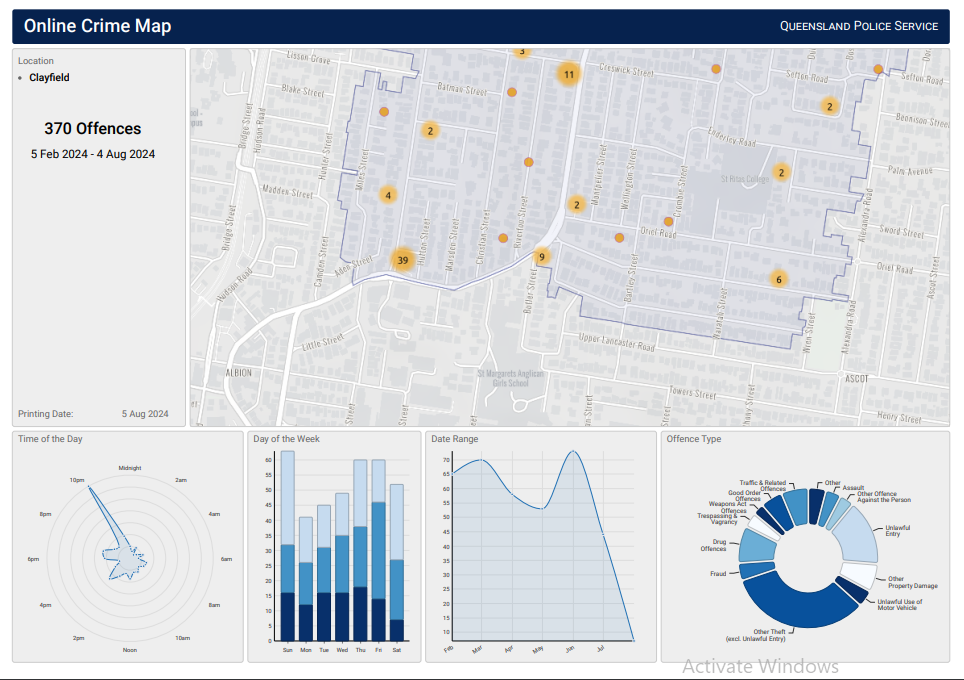
Photo credit: QPS/Online Crime Map
This incident is just one example of the rising crime rates in Clayfield. According to the Queensland online crime map, the suburb recorded 370 offences in the past six months, from 5 February to 4 August 2024. Many of these crimes occurred along Junction Road and Hutton Street.
The top three categories of crime in Clayfield during this period were:
Other theft (excluding unlawful entry): 130 incidents
Local authorities urge residents to remain vigilant and report any suspicious activities as they work to address the growing safety concerns in the area.
Queensland Rail (QR) and Australia Post have launched a trial of free, round-the-clock Parcel Lockers at five South East Queensland train stations. Eagle Junction station is the first to unveil these secure lockers, enhancing commuter convenience.
This 12-month trial will extend to Varsity Lakes, Carseldine, Central, and Richlands stations in the coming months. The initiative aims to seamlessly integrate parcel collection into daily commutes, allowing customers to retrieve their deliveries within 48 hours at their convenience.
Drew Brock, QR’s Acting General Manager Station Customer Service, emphasised the commitment to enhancing the customer experience and noted the potential commercial benefits of this collaboration.
Josh Bannister, Australia Post Executive General Manager Retail, expressed enthusiasm for the partnership, highlighting its potential to streamline commuter parcel collection and complement the nationwide network of over 750 Parcel Locker locations.
A private, concrete air raid shelter on Hudson Road in Wooloowin is a reminder of the community’s wartime resilience. Built during World War II in response to the looming threat of Japanese air raids after the bombing of Pearl Harbour and Darwin, the shelter is a testament to the collective anxiety and preparedness of the time.
Recognised as a local heritage site, the Hudson Road shelter links to Brisbane’s wartime past.
At the time this private shelter was built, a government mandate for air raid shelters in public gathering places saw over 200 public shelters erected. The Wooloowin shelter, characteristic of the Queenslander style, is a rare example of a private shelter, often built in front yards with varied materials and construction depending on individual resources.
It reveals the measures taken by everyday citizens to protect themselves and their families during a national crisis, offering a glimpse into the realities of the home front.
Preserving this structure allows future generations to reflect on the societal impact of World War II on Brisbane’s residents. The shelter is a physical connection to a time of uncertainty and fear, reminding us of the community’s strength and resourcefulness in the face of adversity.
It is a unique piece of history that continues to educate and engage locals and visitors alike. Other examples of backyard shelters are found elsewhere in the city.
Parents of students at St Rita’s College in Clayfield are calling for police involvement following a “smash or pass” rating scandal involving their children’s photos.
The controversy, which also implicates St Joseph’s Nudgee College students, has raised serious concerns about privacy and online behaviour among teenagers.
According to reports, a Year 8 St Rita’s student shared individual photos of her entire class with a Nudgee College boy. Subsequently, a video featuring these images was allegedly created and uploaded to TikTok.
One St Rita’s parent, who wished to remain anonymous, stated, “We have asked the school to refer this matter to the police.” The parent expressed scepticism about claims that the material had not been widely shared on social media, citing the likelihood of redistribution among teenagers.
St Rita’s College has reportedly suspended the student who initially shared the images for one day. The school’s deputy principal, Catherine Allen, informed parents that efforts were being made to remove the shared information.
Nudgee College principal Scott Thomson has denied allegations that their students used social media to rate the attractiveness of St Rita’s students. In a letter to parents, Thomson stated, “Based on our investigations, there is no evidence to support the allegations in the story.” He acknowledged that a Nudgee student had shared St Rita’s student identification photos with a small group of peers but maintained that the school was unaware of any public sharing on social media.
A student from St Joseph’s Nudgee College was also involved in the drama. Photo Credit: Wikipedia / Kgbo
The incident has sparked broader discussions about the prevalence of “smash or pass” rating games in Brisbane schools. A parent from another local school, All Hallows, commented on the widespread nature of these activities, describing them as “incredibly damaging to kids” with potentially “horrific” fallout.
A 97-year-old woman in Clayfield has sold her $2.3 million home, where she has lived since she was three years old. The sale, after 94 years, marks a significant moment in the local real estate market.
The much-loved home at 64-66 Kalinga Street, Clayfield, Queensland, sold for $2.35 million at an auction on 20 July 2024. This purchase combined forces to portray the high demand for homes in this area, contributing to a 60.3 per cent national clearance rate over that weekend.
Photo Credit: realestate.com.au
Photo Credit: realestate.com.au
This iconic Queenslander home boasts a sprawling 810sqm block—this family home has been around for almost a century. It had original features, including its VJ wall panels, sage green roof and patterned wallpaper, which also drew more than 100 onlookers and fierce competition from six bidders among the 17 who registered.
The two bedroom house, known for its timber structure, handsome verandah, and elevated position, backs onto Kalinga Park with all the picturesque views and direct access to green spaces that entails.
Photo Credit: realestate.com.au
The property, which Ray White Ascot listing agent Vanessa Harte described as “cute as a button,” sold to a family who will renovate and live in it. The sale is important to her, Harte added, as the seller’s family is helping her downsize.
The vendor has seen some big changes in the Brisbane real estate market over all the decades. According to data from Macquarie University, in 1973, a typical Brisbane house cost $17,500. The sale of this house signifies both an increase in property value and the owner’s strong attachment to her home and community.
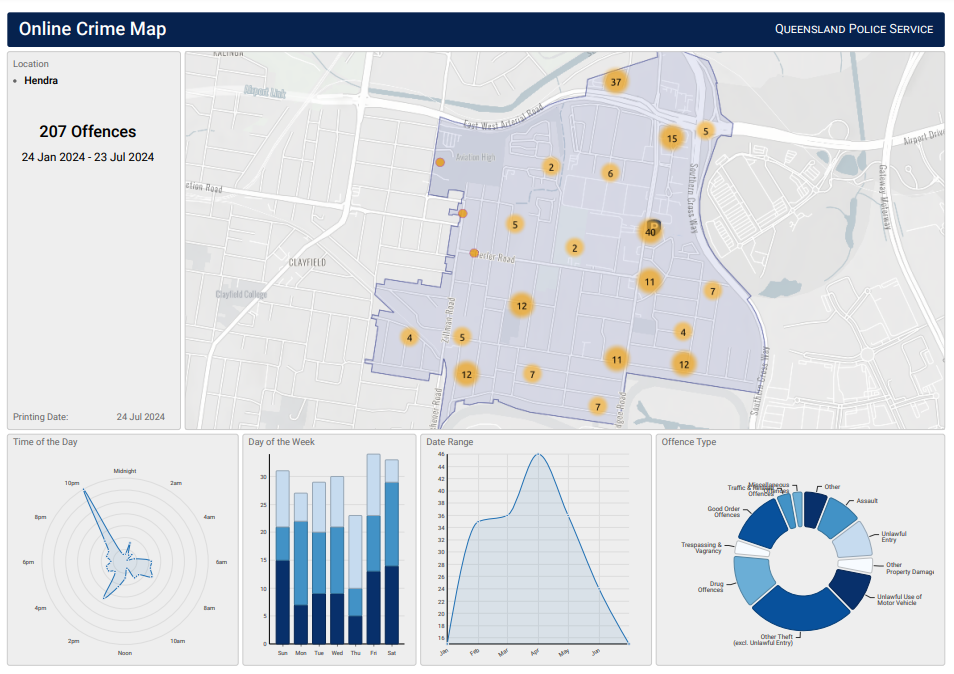
Based on the police data from 24 January to 23 July 2024, a total of 207 offences were recorded in the area, raising concerns among local residents and authorities alike.
The Online Crime Map, a tool used by Queensland Police to track and analyse crime patterns, showed 56 cases of theft reported during this period.
Photo credit: QPS Online Crime Map
Following closely behind are good order offences, accounting for 28 cases. While many of these are minor infractions such as consuming liquor in public places or going armed to cause fear, authorities warn that some instances can be more serious.
In a recent incident highlighting the ongoing crime issues in the area, Queensland Police charged two individuals in connection with an alleged break and enter at a Hendra residence. The event unfolded on Tuesday, July 16, when a vigilant neighbour spotted a suspicious man on CCTV walking alongside an elderly resident’s home on Mein Street.
Police quickly responded to the call and apprehended a 35-year-old woman from Zillmere, who was allegedly acting as a lookout. A 40-year-old man from Brighton was caught fleeing the scene with stolen property and drug paraphernalia. Both suspects are scheduled to appear in Brisbane Magistrates Court on August 19, facing multiple charges including trespass, burglary, and drug-related offences.
This recent break-in serves as a stark reminder of the ongoing challenges faced by law enforcement in the area. Local authorities are urging residents to remain vigilant and report any suspicious activities to help combat the rising crime rates in Hendra.
As the community grapples with these concerning statistics, questions arise about the factors contributing to the increase in criminal activity and what measures can be taken to ensure the safety and security of Hendra’s residents in the coming months.
A two-bedroom Clayfield unit at 1/78 Wagner Road sold for $660,000, attracting an unprecedented 24 registered bidders and exceeding the area’s median price for similar properties by a significant margin.
The 132-square-meter ground floor apartment, built in 1970, showcases the enduring appeal of Clayfield’s older housing stock. Known for spacious layouts and features like separate laundry rooms, these properties are increasingly sought-after in a market favouring quality and location.
Drew Davies of Place Ascot, who handled the sale with colleague Guy Horsley, noted the exceptional interest in the property. “It was the most registered bidders we’ve seen for a single auction in recent times,” Davies remarked, underscoring Clayfield’s current market heat.
The sale price represents a substantial increase from the $44,000 the previous owner paid 44 years ago, reflecting Clayfield’s long-term growth potential. More recently, the suburb has seen a 19% jump in median prices for two-bedroom units over the past year, reaching $545,000.
Clayfield’s proximity to Brisbane CBD — just 10 kilometres away — continues to be a major draw. The suburb is attracting a diverse range of buyers, from first-time homeowners to downsizers and investors, all vying for a piece of this desirable northside locale.
The strong result aligns with a broader trend in Clayfield and surrounding areas. “We’ve seen a huge surge in interest for apartments over the last year, especially for those in small blocks with low body corps in premium locations,” Davies explained, highlighting Clayfield’s particular appeal in this regard.
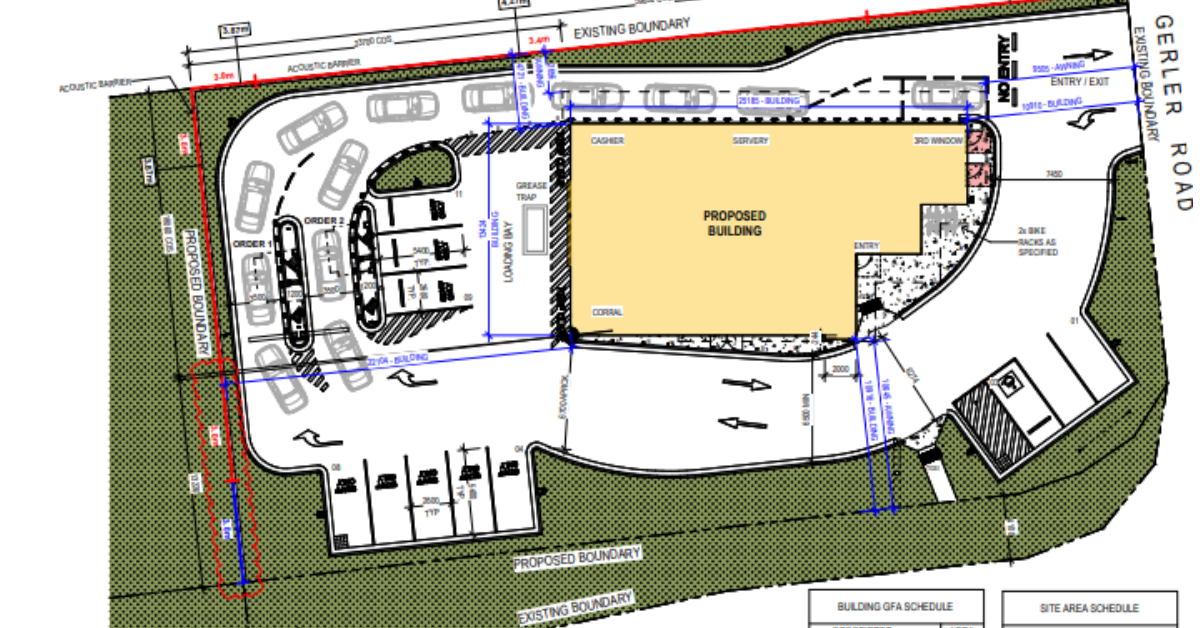
The application, submitted for the property at 330 Nudgee Road, details designs for a modern fast-food restaurant by PA Architects.
The 293-square-metre restaurant would occupy a 2,120-square-metre corner site, replacing the existing vehicle rental business and accessing both Nudgee and Gerler Roads. The development would include landscaping and an acoustic fence to minimise the impact on surrounding residential areas.
Urbis, the planning consultant for the project, argues that the proposal aligns with the area’s existing and historical land use. They emphasise that the development would not compromise the residential character of the neighbourhood or reduce the availability of residential land.
The proposal outlines a pedestrian pathway to the Nudgee Road footpath, ensuring accessibility for pedestrians and cyclists. The drive-through, designed with two lanes, is expected to accommodate 12 cars, aiming to streamline traffic flow and minimise congestion.
The development application is currently under review by the Brisbane City Council. Should it be approved, the new McDonald’s would join the existing Nudgee Service Centre location on Nudgee Road, further expanding the fast-food chain’s presence in the area.
For decades, the Kalinga Picture Palace, later known as the Star Theatre, was a hub of entertainment and community connection. Now, nearly a century after its inception, the theatre’s story is being pieced together, shedding light on its evolution and its role in the lives of locals.
The first documented mention of the theatre appeared in a 1920 electoral advertisement in the Daily Standard newspaper. It was initially an open-air venue known as the Kalinga Picture Palace, one of two locations hosting a political event that evening.
By 1926, the venue had been rechristened the Star Theatre. A few years later, in 1929, the Star underwent significant renovations, transitioning from an open-air cinema to a fully enclosed building with a roof. This improvement enhanced the viewing experience and allowed for year-round screenings.
The Talkies Arrive
In 1931, after a brief closure, the Star Theatre reopened with state-of-the-art RCA sound equipment. This marked a pivotal moment in the theatre’s history, as it could now screen “talkies,” or films with synchronised sound. This technological advancement attracted larger audiences and solidified the Star’s position as a premier entertainment destination.
The Star Theatre was more than just a place to watch movies. It served as a gathering point for the community, hosting events for local groups and schools. Kedron High School, for instance, is said to have used the theatre for children’s talent shows. This multi-faceted role made the Star Theatre a vital part of Kalinga’s social fabric.
An Untimely End
Sadly, the Star Theatre’s story came to an abrupt end in the early 1960s when a devastating fire destroyed the building. In its place, a service station was built, leaving behind only memories and a few scattered records of the theatre’s vibrant past.
Although the physical structure of the Star Theatre is long gone, its legacy lives on in the memories of those who experienced its magic. The story of the Kalinga Picture Palace and its transformation into the Star Theatre is a testament to the enduring power of cinema and its ability to bring communities together.
As historians and enthusiasts continue to uncover more details about this beloved venue, its importance in the history of Kalinga and Brisbane’s cinematic landscape becomes even clearer.
Three Clayfield schools have emerged as strong contenders in the latest rankings of Queensland’s top 150 high schools, according to an independent analysis by Better Education.
The 2023 rankings, based on Year 9 English and Maths results, reveal significant improvements for schools outside of Brisbane, with several making impressive strides.
Clayfield College on Gregory St is among the 19 new entries in the 2023 rankings, showcasing the growing academic strength of institutions outside the metropolitan area. The school placed alongside St Rita’s College on Enderley Rd, ranked at #28, and Aviation High School on Widdop St, ranked at #123.
Clayfield College is an independent, co-educational, Uniting Church Day, and boarding school. Established in 1931, it caters to students from preschool to Year 12. The college is known for its focus on academic excellence, pastoral care, and a wide range of co-curricular activities.
St Rita’s College is an independent, Roman Catholic, single-sex secondary school for girls. Founded in 1926 by the Presentation Sisters, it serves students from Years 7 to 12. The college emphasises academic achievement, faith formation, and social justice, offering a well-rounded education that prepares young women for leadership roles.
Aviation High School is a state secondary school that specializes in aviation-related studies. Established in 2010, it caters to students in Years 7 to 12 who are interested in pursuing careers in the aviation industry. The school offers a unique curriculum that combines academic subjects with practical training in aviation, aerospace engineering, and aeronautical science.
While the top four positions remain unchanged, with esteemed institutions such as the Queensland Academy for Science, Mathematics, and Technology and Brisbane Grammar School leading the pack, several schools have made notable climbs.
Somerville House and St Peters Lutheran College, both in Brisbane, each jumped four spots, securing fifth and sixth place, respectively. AB Paterson College on the Gold Coast also made a significant leap, rising nine places to break into the top 15.
Rank
School
Locality
Sector
State Overall Score
2022 Rank
1
Queensland Academy for Science, Mathematics and Technology
Toowong
Government
100
1
2
Brisbane Grammar School
Brisbane
Non-Government
100
2
3
Brisbane Girls Grammar School
Brisbane
Non-Government
100
3
4
Brisbane State High School
South Brisbane
Government
100
4
5
Somerville House
South Brisbane
Non-Government
100
9
6
St Peters Lutheran College
Indooroopilly
Non-Government
100
10
7
Somerset College
Mudgeeraba
Non-Government
100
5
8
Ormiston College
Ormiston
Non-Government
100
6
9
St Joseph’s College Gregory Terrace
Brisbane
Non-Government
99
11
10
Cannon Hill Anglican College
Cannon Hill
Non-Government
99
13
11
Whitsunday Anglican School
Beaconsfield
Non-Government
99
7
12
Anglican Church Grammar School (Churchie)
East Brisbane
Non-Government
99
15
13
AB Paterson College
Arundel
Non-Government
99
22
14
St Aidan’s Anglican Girls’ School
Corinda
Non-Government
99
8
15
All Hallows School
Brisbane
Non-Government
99
16
16
Emmanuel College
Carrara
Non-Government
99
24
17
St Margaret’s Anglican Girls School
Ascot
Non-Government
99
14
18
Ipswich Grammar School
Ipswich
Non-Government
99
12
19
Redeemer Lutheran College
Rochedale
Non-Government
99
21
20
Matthew Flinders Anglican College
Buderim
Non-Government
99
19
21
All Saints Anglican School
Merrimac
Non-Government
99
17
22
Hillbrook Anglican School
Enoggera
Non-Government
99
27
23
Mansfield State High School
Mansfield
Government
99
29
24
Citipointe Christian College
Carindale
Non-Government
98
34
25
Brisbane Boys’ College
Toowong
Non-Government
98
18
26
Sheldon College
Sheldon
Non-Government
98
23
27
John Paul College
Daisy Hill
Non-Government
98
31
28
Indooroopilly State High School
Indooroopilly
Government
98
35
29
Sunshine Coast Grammar School
Forest Glen
Non-Government
98
45
30
Mt St Michael’s College
Ashgrove
Non-Government
98
25
31
St Rita’s College
Clayfield
Non-Government
98
28
32
Northside Christian College
Everton Park
Non-Government
98
20
33
Immanuel Lutheran College
Buderim
Non-Government
98
69
34
Annandale Christian College
Annandale
Non-Government
98
74
35
Loreto College
Coorparoo
Non-Government
98
39
36
Stuartholme School
Toowong
Non-Government
98
44
37
Ipswich Girls’ Grammar School
East Ipswich
Non-Government
98
33
38
Padua College
Kedron
Non-Government
98
New Entry
39
St Andrew’s Anglican College
Peregian Springs
Non-Government
98
47
40
Moreton Bay College
Manly West
Non-Government
97
52
41
Marist College Ashgrove
Ashgrove
Non-Government
97
32
42
Kelvin Grove State College
Kelvin Grove
Government
97
48
43
Trinity Anglican School
White Rock
Non-Government
97
40
44
Brisbane South Secondary College
Dutton Park
Government
97
New Entry
45
St John’s Anglican College
Forest Lake
Non-Government
97
57
46
Mount Alvernia College
Kedron
Non-Government
97
41
47
Cavendish Road State High School
Holland Park
Government
97
46
48
Moreton Bay Boys College
Manly West
Non-Government
97
62
49
Townsville Grammar School
North Ward
Non-Government
97
26
50
Villanova College
Coorparoo
Non-Government
97
60
The rankings reveal that public schools are holding their own against some of the state’s most prestigious private institutions. Five public schools, including Mansfield State High and Indooroopilly State High, have secured positions within the top 50.
Regional schools have also demonstrated remarkable improvement. Annandale Christian College in Townsville, St Luke’s Anglican School in Bundaberg, and Tamborine Mountain State High School in the Scenic Rim have all made significant jumps in the rankings.
Other notable advancements include Immanuel Lutheran College on the Sunshine Coast, Springfield Anglican College in Ipswich, and St Andrew’s Lutheran College on the Gold Coast, all of which have climbed considerably in the rankings.
The 2023 list highlights the dynamic nature of Queensland’s educational landscape, with schools across the state striving for excellence. The inclusion of new entries and the impressive progress of numerous institutions signal a promising future for education in the region.













.jpg)
