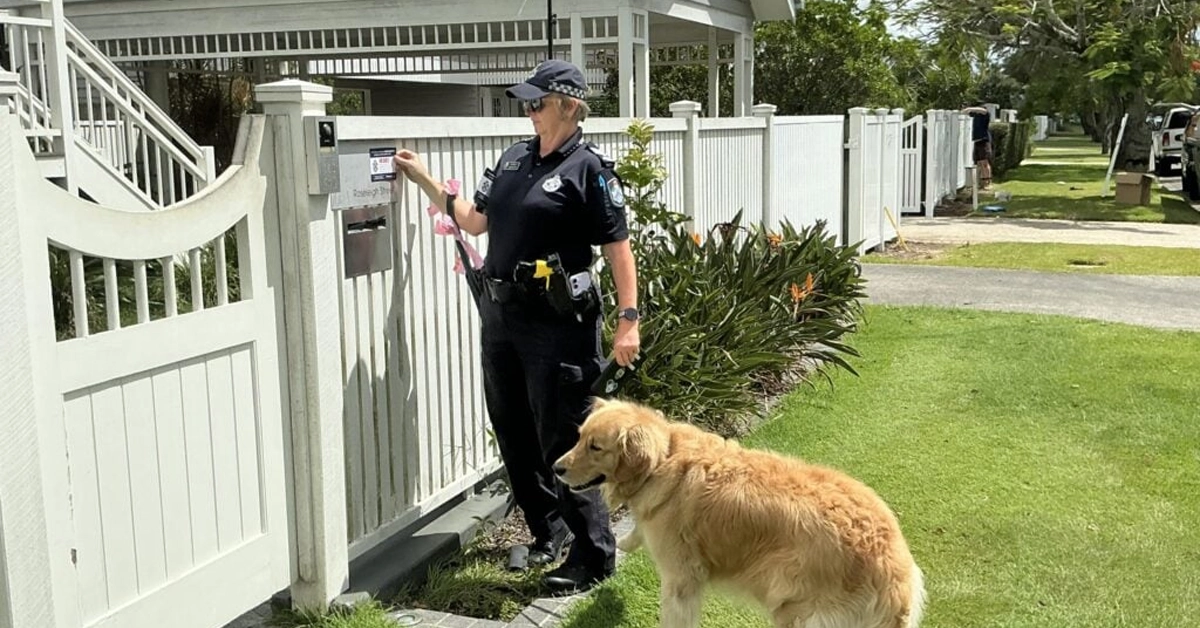
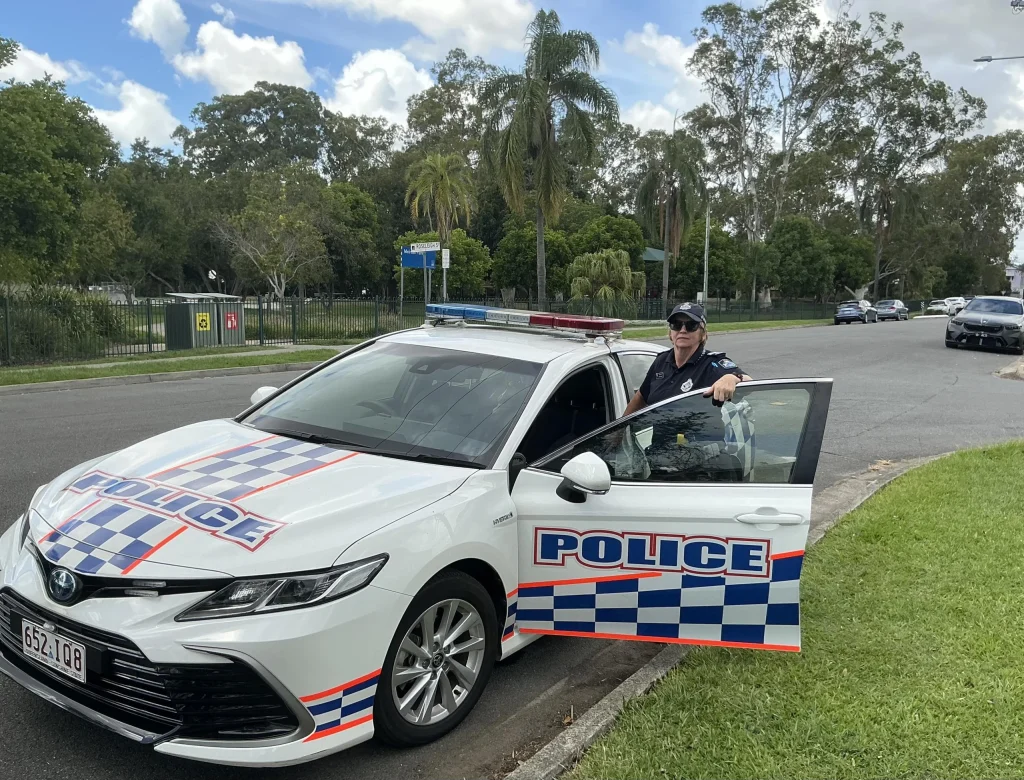
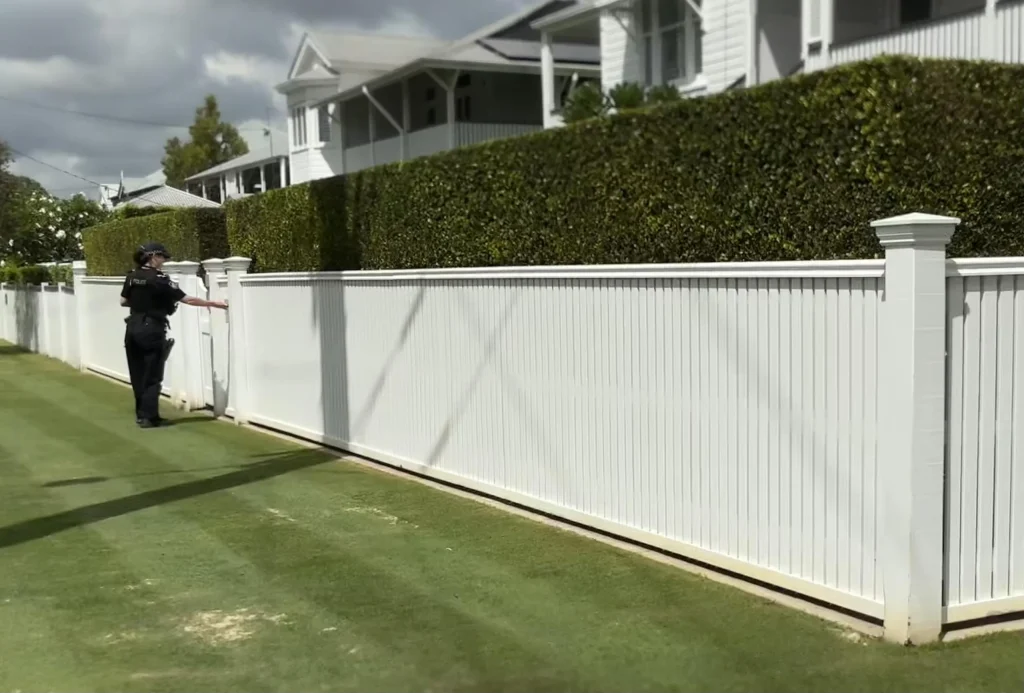
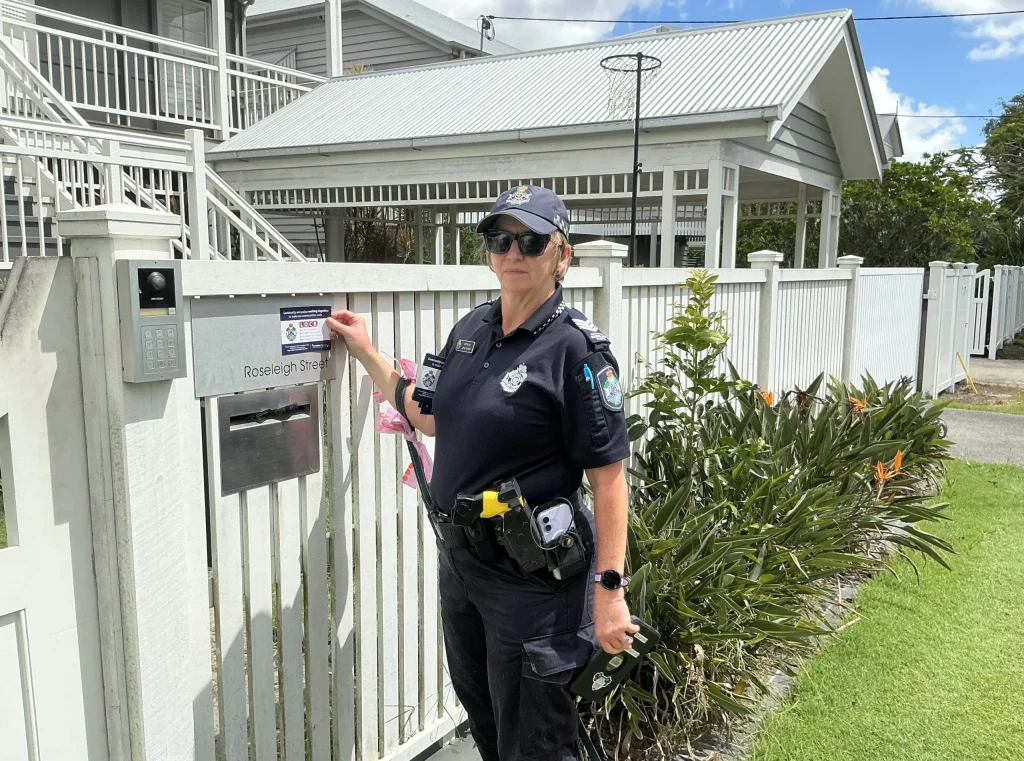
Police officers visited streets in Kalinga this week, distributing home security information to residents as part of ongoing crime prevention efforts in the suburb.
Senior Constable Kim Richter confirmed that officers attended the area around Roseleigh Street and Kent Road on Monday 23 February, providing letterbox drops with information on home security measures and crime reporting options.
The Queensland Police Service visit comes as part of broader community policing initiatives aimed at preventing opportunistic offences in Brisbane’s northern suburbs.
“While offenders are responsible for the crimes they commit, we can work together to prevent opportunistic offences,” a QPS statement said.
Residents have been encouraged to review their home security arrangements, with police recommending several practical measures to deter potential intruders.
Key recommendations include installing key-operated locks on doors and windows to make unauthorised entry more difficult, and marking valuable items with identification such as microdot technology or engraving to make stolen property harder to sell.
Police have also suggested making it more challenging for offenders to exit properties with stolen goods, though specific methods were not detailed in the community information.
Kalinga residents seeking additional crime prevention advice can access the Queensland Police Service’s home and multi-residential security resources online at the QPS website.
Authorities have reminded the community that anyone witnessing a crime in progress or facing immediate danger should call Triple Zero (000). For non-urgent matters, residents can contact Policelink on 131 444 or submit information through the online suspicious activity form available 24 hours a day at www.police.qld.gov.au/reporting.
Those wishing to provide information anonymously can contact Crime Stoppers on 1800 333 000 or visit www.crimestoppersqld.com.au.
The police presence in Kalinga reflects ongoing efforts by Queensland Police to maintain community safety through both enforcement and prevention strategies across Brisbane suburbs.
Clayfield and Kalinga are among 18 Brisbane suburbs where planning rules may change to allow more housing close to public transport and local shops, with a community consultation period now open until Friday 20 March 2026.
The More Homes, Sooner initiative proposes updates to the low-medium density residential zone, known as the LMR zone, which covers around 14 per cent of Brisbane’s residential land and includes pockets of both suburbs. The changes aim to make it easier and more affordable to build the kinds of homes that key workers, younger buyers, couples and downsizers are actually looking for, in suburbs they already know and love, rather than pushing growth to the city’s fringes.
New dwelling approvals in LMR zones across Brisbane fell from around 1,100 homes per year to just 445 in 2023, as rising construction costs made smaller infill projects increasingly difficult to stack up financially. The proposed changes are designed to reverse that trend.
What Could Change in Clayfield and Kalinga
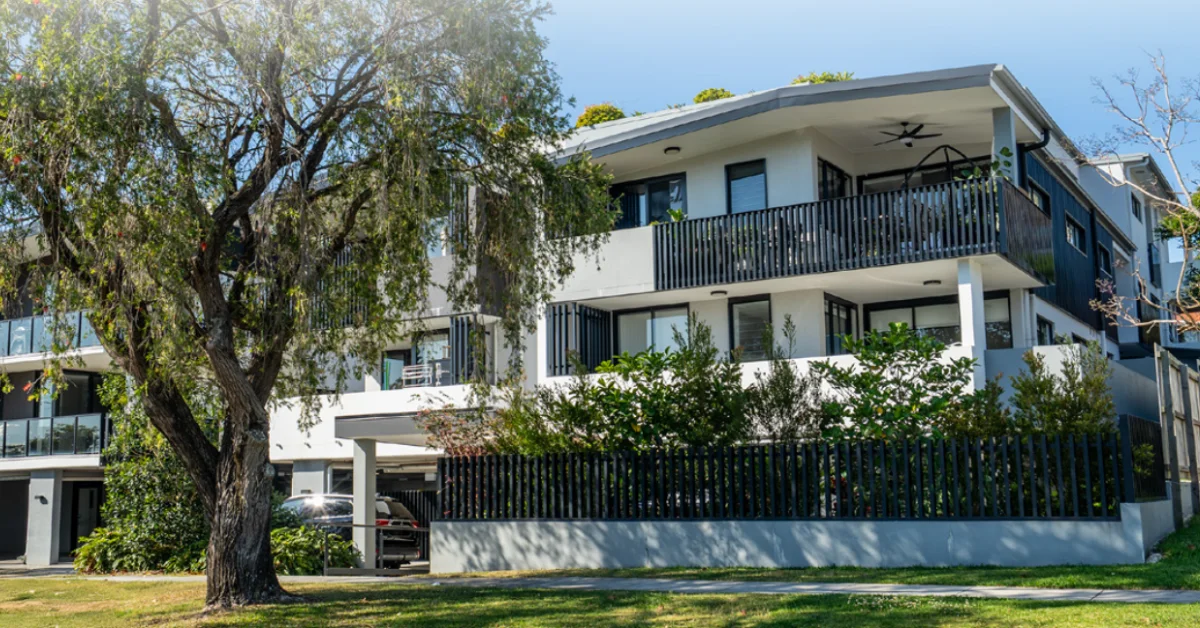
The LMR zone in Clayfield and Kalinga currently allows for two to three storey buildings on lots of at least 400 square metres, accommodating townhouses, duplexes, row houses and small apartment buildings. Under the More Homes, Sooner proposals, the baseline height allowance across LMR zones would rise to a consistent three storeys. Properties within 400 metres walking distance of a high-frequency public transport stop or a shopping centre, classified as Key Locations, would be eligible for up to four storeys on lots of 800 square metres or more.
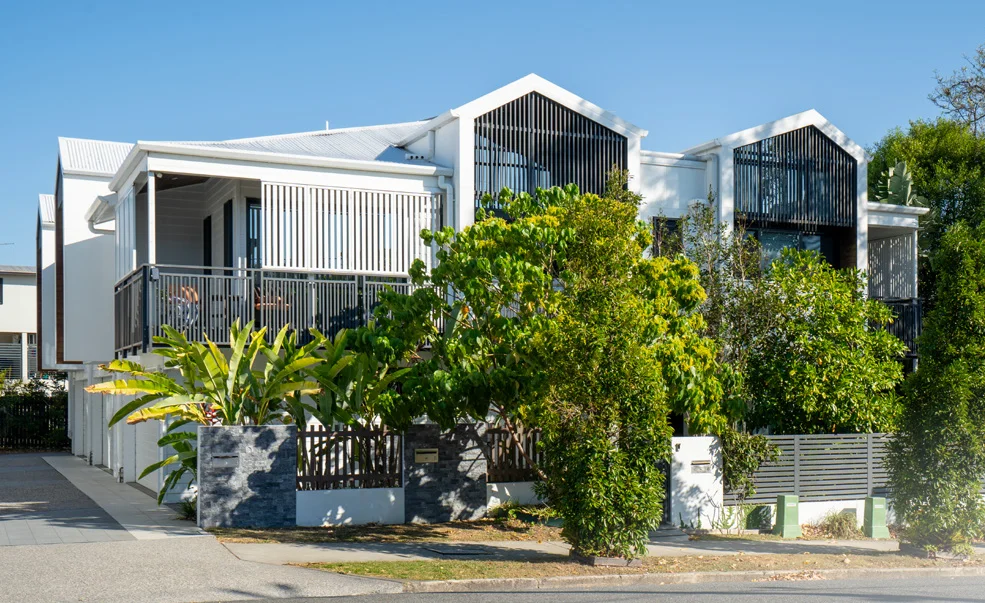
Minimum lot sizes are also proposed to change, dropping to 120 square metres in some circumstances to enable small freehold houses and terrace-style homes on compact blocks. Low density residential properties within 300 metres walking distance of a shopping centre would also become eligible for subdivision into 300 square metre lots, expanded from the current 200 metre threshold.
Photo Credit: BCC
On-site car parking requirements would be adjusted citywide to reflect declining car ownership and improved access to public transport. A two-bedroom unit currently requires two car spaces; under the proposed changes that would reduce to 1.5 spaces, or 1.2 spaces in Key Locations. The planning document notes that a single car park space can add up to $82,000 to the cost of a unit outside the inner city, and that reducing this requirement directly improves affordability for buyers and renters.
Neighbourhood Character Protected by Design
The changes come with design safeguards built in. Minimum setbacks from existing freestanding houses, maximum building footprints, and requirements for street tree planting are all part of the proposed framework to ensure new development integrates into existing streetscapes rather than overwhelming them.
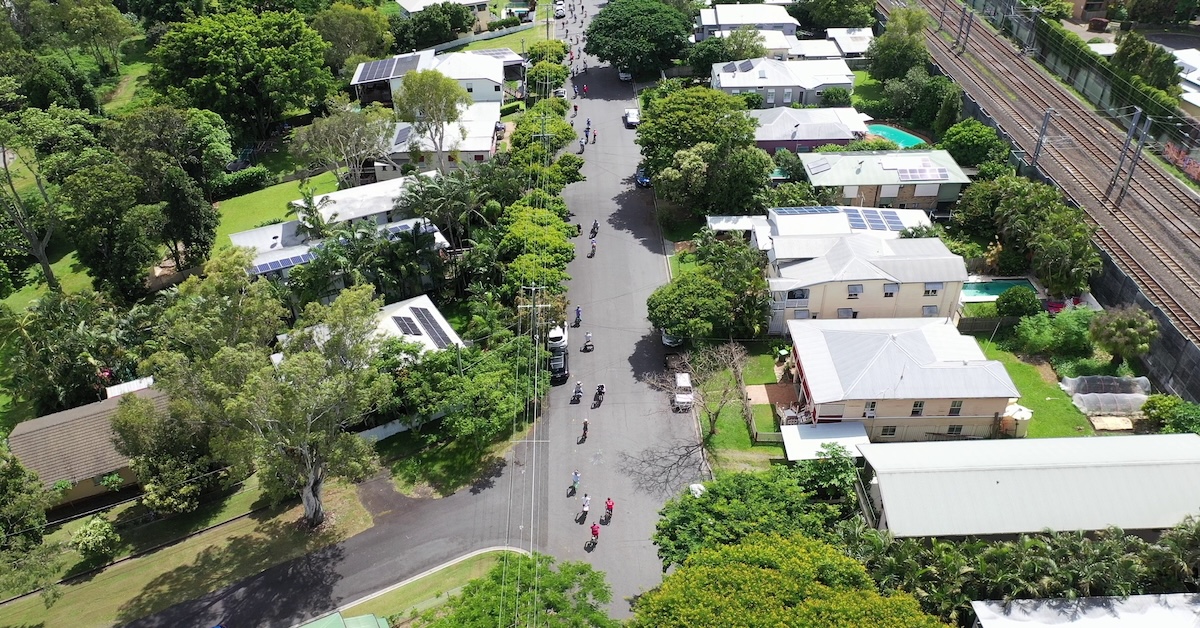
Planning consultants from Brisbane firm Therefor Group have noted that character-protected areas in suburbs with heritage overlays are unlikely to be affected. In Clayfield and Kalinga, where well-maintained Queenslander homes and post-war cottages define much of the residential streetscape, that distinction matters. The LMR zone typically occupies pockets near transport corridors and centres rather than the broadest residential streets, meaning character areas and designated heritage precincts sit largely outside the scope of the proposed changes.
Photo Credit: BCC
More than half of all Brisbane households are made up of single people or couples without children, yet 71 per cent of the city’s homes have three or more bedrooms. The initiative responds directly to that mismatch, aiming to create housing pathways for people at every stage of life within established, well-serviced suburbs.
How to Have Your Say
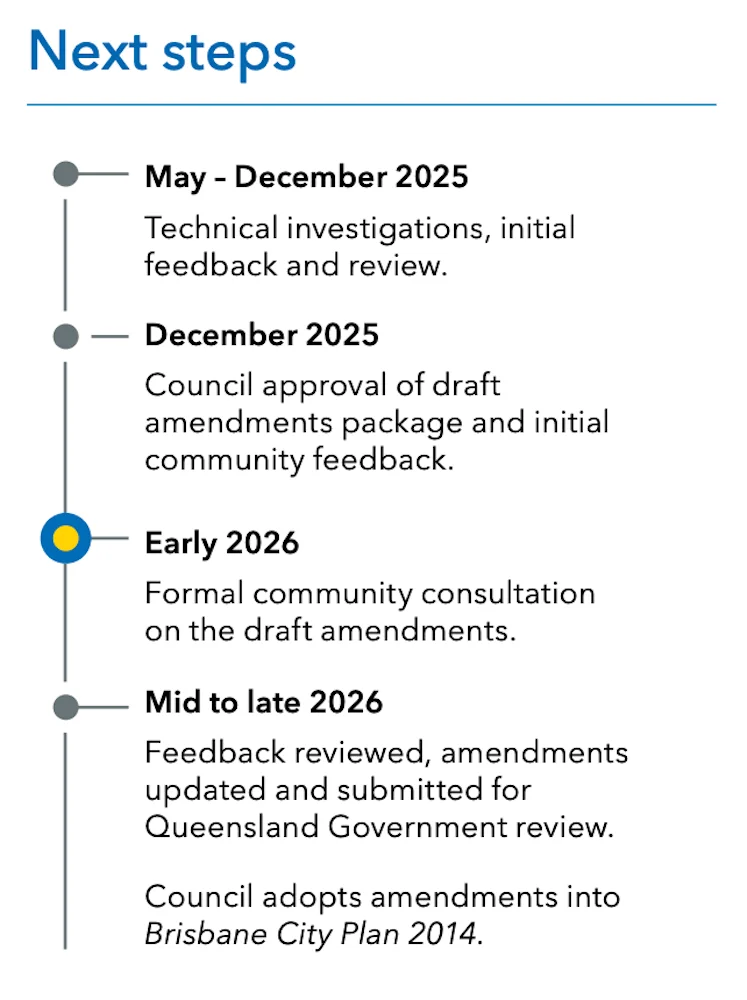
Formal community consultation on the More Homes, Sooner draft amendments is open now and closes Friday 20 March 2026. Residents can share their feedback online at brisbane.qld.gov.au by searching “More Homes, Sooner”, by emailing strategicplanninghousing@brisbane.qld.gov.au, or by calling 07 3403 8888. Written submissions can also be posted to Strategic Planning (More Homes Sooner), BCC, GPO Box 1434, Brisbane QLD 4001.
Following the consultation period, feedback will be reviewed and amendments updated before being submitted for state review and formally adopted into Brisbane City Plan 2014. That process is expected to conclude by late 2026.
Clayfield sits at the centre of a safety concern that riders say stretches across Brisbane’s northside, after a key link in the North Brisbane Bikeway ends near Eagle Junction and pushes people on bikes into traffic and parked cars.
An online petition calling for safer cycling on Dickson Street drew 636 signatures before it closed on 26 March 2025. The petition lists its principal petitioner as a Wooloowin resident and focuses on the Clayfield–Eagle Junction area, where the protected bikeway is set to stop at Price Street.
It argues that many riders will still use Dickson Street to reach Eagle Junction station and other connections, but will be forced to ride between parked cars and faster-moving traffic. The petition asked Council to lower the speed limit from 60 km/h to 40 km/h and remove on-street parking along about 500 metres of Dickson Street.
They said the change would reduce the risk of collisions and improve safety for people traveling to Eagle Junction and nearby workplaces, including jobs linked to Brisbane Airport.
Why the Issue Reaches Beyond Clayfield
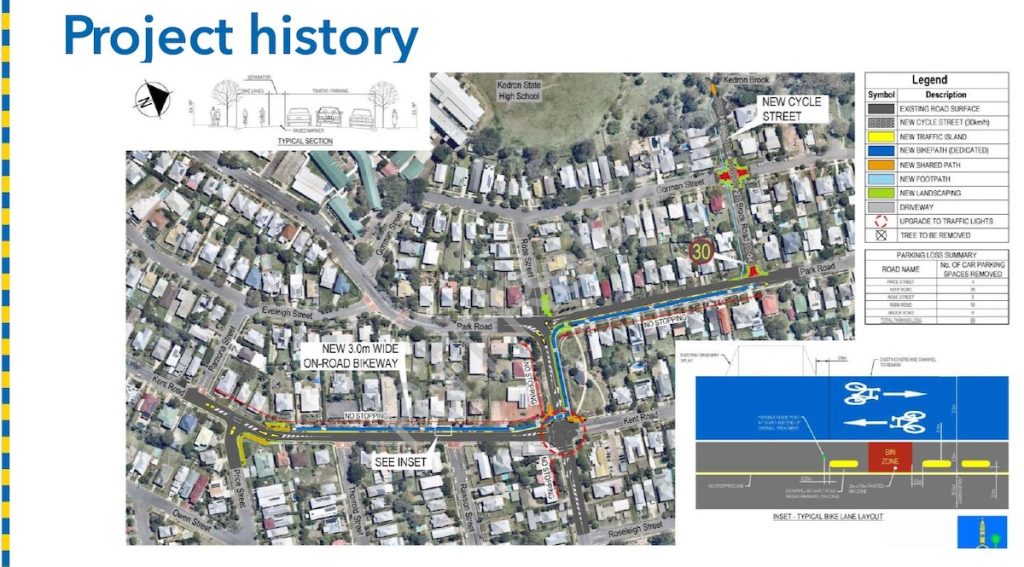
Although the petition focuses on a short section of road, the route it discusses forms part of a wider network used by riders travelling between suburbs. The petition describes how the North Brisbane Bikeway would be routed away from Dickson Street via Price Street, Kent Road and Brooks Street before rejoining the Kedron Brook corridor.
For people travelling through the area rather than living in Clayfield, the concern is that the most direct path to Eagle Junction can still run along Dickson Street, where riders say conditions feel less protected once the separated bikeway ends.
What the Working Group Supported
In a Facebook post dated 8 February 2026, the cycling advocacy group Space4cyclingbne said it had seen a 2024 Community Working Group report reviewing the alignment and design of what was intended to be Stage 5 of the North Brisbane Bikeway. The group stated that the working group supported building the missing connection by continuing north along Dickson Street after Price Street, through Eagle Junction, and then connecting to the Kedron Brook Bikeway via Jackson Street, with minor design changes suggested.
Photo Credit: Space4cyclingbne/Facebook
Brisbane City Council’s North Brisbane Bikeway Stage 5 project page confirms a Community Working Group met in early 2024 and later notes that broader community concerns were raised about the Price Street to Kedron Brook alignment after the working group ended. Council states it has discontinued work on that alignment and will return to a previous Kent Road-based concept that uses surrounding streets to connect to the Kedron Brook Bikeway.
What Residents Say They’re Still Waiting For
Space4cyclingbne said campaigners were disappointed construction did not proceed in 2025 and claimed some petition signatories had not seen a clear update nearly a year later. Council’s project page states responses to two petitions were endorsed by Council committees on 20 January 2025, while the petition page itself does not display a detailed public reply.
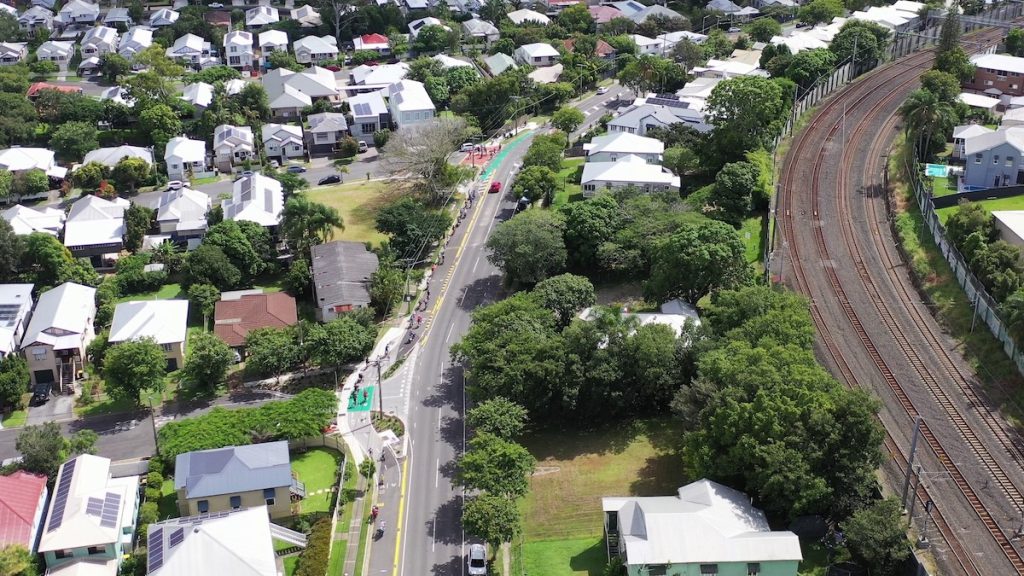
For locals and riders passing through the area, the practical issue remains the same: the protected bikeway currently stops at Price Street, and the route toward Eagle Junction is left to on-road conditions.
Photo Credit: Space4cyclingbne/Facebook
Community Interest Hasn’t Faded
The Brisbane North Bicycle User Group highlighted the petition campaign in a 2025 post, encouraging residents to support calls for safer conditions in the Dickson Street corridor, which it framed as a current local concern for riders. The group’s update is available at Brisbane North BUG.
With Council’s attention now on a different alignment, advocates have indicated a Kent Road connection could still add value, but they continue to argue that safety on Dickson Street matters for people trying to reach Eagle Junction and connect into the wider network.
City officials have identified Kalinga and Clayfield as two of 18 Brisbane suburbs under review for potential changes to zoning rules, which could increase building heights and reduce minimum lot sizes to address housing supply challenges.
BCC is conducting a broad review of low-to-medium density residential (LMR) zones across the city, a designation that covers 14 per cent of its area. Kalinga and Clayfield are among the suburbs currently zoned for two-to-three storey buildings, with a minimum lot size of 400 square metres. These planning standards have remained unchanged despite sustained population growth and rising housing costs.
According to city official Adrian Schrinner, approvals for new dwellings in LMR zones dropped to 445 two years ago, well below the previous ten-year average of over 1,100 per year. The decline has occurred despite increasing housing demand across the city.
The proposed review includes increasing permitted building heights to five storeys in selected LMR suburbs such as Kalinga and Clayfield and reducing the minimum lot size to 300 square metres. Other changes being considered include easing car parking requirements and removing regulatory barriers. The goal is to enable the construction of up to 6,000 new homes in LMR areas by 2030.
Sites located near public transport, shops, schools, and major roads will be prioritised for higher density to maximise access to existing infrastructure. Brisbane’s strategy aligns with the South East Queensland Regional Plan target, which requires around 60 per cent of new housing to come from infill development.
Planning consultants, including those from the Therefor Group, have suggested that character-protected suburbs like Paddington are unlikely to be impacted. In contrast, areas like Kalinga and Clayfield, which fall under current LMR zoning, may experience moderate redevelopment that includes terrace homes or dual occupancy dwellings.
The Property Council of Australia has endorsed the review, stating that the LMR zoning framework is underperforming in terms of supply. Master Builders Queensland also supported the announcement but noted that the construction industry continues to face shortages in skilled labour, which could constrain the pace of delivery.
Community sentiment has included calls for more inclusive engagement, with suggestions that changes should be led by residents and not solely developers. Council has confirmed that public consultation will form part of the process before final decisions are made.
Consultation on the proposed changes is expected to begin soon, with the council aiming to implement revisions within the year. The zoning review is part of a wider strategy to expand housing options and maintain the city’s liveability as Brisbane’s population continues to grow.
A Kalinga father suffered severe injuries, including brain trauma and grated feet, after being dragged by his car as teenage thieves sped away, resulting in one of the teens receiving an 18-month probation sentence.
The incident occurred on 11 May last year at the Charlton family home in Kalinga, a suburb in Brisbane’s inner north.
Benjamin Charlton, a local veterinarian, attempted to stop the theft of his Toyota Prado but was dragged along the road, sustaining significant injuries. The impact resulted in a brain injury, requiring extensive medical attention, and severe damage to his feet. Mr Charlton described the horrifying moment he looked down and struggled to recognise his own bloodied and damaged feet.
He also recounted the fear and uncertainty his family faced as doctors assessed his brain injury, which included bleeding. Doctors warned of potential surgery if the bleeding did not subside. Mr. Charlton now faces a lifelong increased risk of seizures and potential permanent vision impairment. His wife, Megan Charlton, found him unconscious and bleeding on the road, fearing the teens would return. She attempted to move him to safety.
One of the teenagers involved pleaded guilty to robbery in company, unauthorised use of a motor vehicle, and assault occasioning bodily harm. The Childrens Court in Brisbane sentenced the teen to 18 months of probation. Judge Ian Dearden ordered the teen to participate in restorative justice, which involves meeting with Mr. Charlton.
The teen had already spent 10 months in juvenile detention on remand. The court also heard that the teenager had committed a separate assault in April, a month before the Kalinga incident, attacking another victim on a city bridge. The stolen vehicle was later stopped by police using road spikes after reaching speeds of over 150km/h through Brisbane and the Gold Coast. The teen is expected to appear in Ipswich Children’s Court on 1 April to plead guilty to unrelated charges.
Mr Charlton expressed his ongoing anger and sadness, stating that while the teenagers involved can move on with their lives, he faces lifelong consequences. He conveyed the emotional trauma of the incident, recalling the fear he and his family experienced. He hoped that the teen would receive help to avoid reoffending.
Mr Charlton explained that the decision to pursue restorative justice rather than a harsher sentence, was made with the hope of rehabilitation. He stated that the emotional and physical scars he sustained may never fully heal.
The incident has caused concern within the Kalinga community, highlighting the issue of youth crime in the area. Residents sympathised with the Charlton family and requested increased measures to prevent similar incidents. The community has rallied around the family, offering support and assistance during their recovery.
For decades, the Kalinga Picture Palace, later known as the Star Theatre, was a hub of entertainment and community connection. Now, nearly a century after its inception, the theatre’s story is being pieced together, shedding light on its evolution and its role in the lives of locals.
The first documented mention of the theatre appeared in a 1920 electoral advertisement in the Daily Standard newspaper. It was initially an open-air venue known as the Kalinga Picture Palace, one of two locations hosting a political event that evening.
By 1926, the venue had been rechristened the Star Theatre. A few years later, in 1929, the Star underwent significant renovations, transitioning from an open-air cinema to a fully enclosed building with a roof. This improvement enhanced the viewing experience and allowed for year-round screenings.
The Talkies Arrive
In 1931, after a brief closure, the Star Theatre reopened with state-of-the-art RCA sound equipment. This marked a pivotal moment in the theatre’s history, as it could now screen “talkies,” or films with synchronised sound. This technological advancement attracted larger audiences and solidified the Star’s position as a premier entertainment destination.
The Star Theatre was more than just a place to watch movies. It served as a gathering point for the community, hosting events for local groups and schools. Kedron High School, for instance, is said to have used the theatre for children’s talent shows. This multi-faceted role made the Star Theatre a vital part of Kalinga’s social fabric.
An Untimely End
Sadly, the Star Theatre’s story came to an abrupt end in the early 1960s when a devastating fire destroyed the building. In its place, a service station was built, leaving behind only memories and a few scattered records of the theatre’s vibrant past.
Although the physical structure of the Star Theatre is long gone, its legacy lives on in the memories of those who experienced its magic. The story of the Kalinga Picture Palace and its transformation into the Star Theatre is a testament to the enduring power of cinema and its ability to bring communities together.
As historians and enthusiasts continue to uncover more details about this beloved venue, its importance in the history of Kalinga and Brisbane’s cinematic landscape becomes even clearer.
Alfred Lutwyche’s journey to becoming a prominent figure in Queensland was not without its trials. Before his legal career took off, he faced a life-altering ordeal—a shipwreck near the remote Amsterdam Island in the Southern Indian Ocean.
Lutwyche, along with his fellow passengers, found themselves stranded on this desolate island, stripped of their possessions and facing an uncertain future. The shipwreck was a test of resilience and survival, one that Lutwyche passed with flying colours.
The details of his survival and eventual rescue remain shrouded in some mystery. Still, the fact that he overcame this adversity and went on to achieve great things speaks volumes about his character and determination. This harrowing experience likely shaped his perspective and perhaps even fueled his ambition, ultimately leading him to play a pivotal role in the development of Kalinga and the legal landscape of Queensland.
Lutwyche’s story, much like the suburb he helped establish, is one of resilience, transformation, and enduring impact. Born in London in 1810, he embarked on a legal career that led him to Australia in the mid-19th century. But his journey was far from smooth sailing. His experiences due to the shipwreck stripped him of his possessions but not his determination.
Upon reaching Sydney, Lutwyche’s legal acumen quickly gained recognition. He was appointed Solicitor-General of New South Wales and later became Queensland’s first Supreme Court judge. Yet, his influence extended beyond the courtroom. He acquired vast tracts of land in the area now known as Kalinga, where he built his stately residence, Kedron Lodge.
Lutwyche’s vision for Kalinga was not merely residential. He envisioned a community anchored in faith and education. In 1865, he donated land for the construction of St. Andrew’s Anglican Church in Brisbane City, a landmark that still stands as a testament to his commitment to the spiritual well-being of the community. He also played a pivotal role in establishing the local school, ensuring that future generations would have access to quality education.
The judge’s legacy is not confined to bricks and mortar. His philanthropic spirit, his dedication to justice, and his unwavering belief in the potential of Kalinga continue to inspire residents. The suburb’s name itself, derived from the Aboriginal word “Kallingga,” meaning “good,” reflects the values Lutwyche instilled in this once-rural outpost.
Today, Kalinga is a thriving suburb, a blend of historical charm and modern amenities. Yet, beneath its contemporary facade lies the indelible mark of Alfred Lutwyche. His story is a reminder that Kalinga is not just a place on a map; it’s a living testament to the enduring power of vision, resilience, and community spirit.