This competition is proudly sponsored by Number Works ‘n Words in Clayfield. Every entrant will receive a free evaluation and a free lesson. All entrants will go into a draw, the winner will receive a whole term’s tuition, worth $650.
TO ENTER: Simply pass the problem below onto your child and ask them to solve it. Then complete the entry form below it. Competition closes on July 31, 2023.
In a bid to address the issue of a housing shortage in Brisbane, the first residents of a repurposed former retirement village in Clayfield have moved into the property.
Partnering with Bric Housing and Communify Queensland Ltd., the project for 37 homes aims to provide long-term accommodation for older Queenslanders who are downsizing or facing homelessness. With the first residents safely in their new homes, the Clayfield property marks a significant milestone in the government’s efforts to tackle the housing crisis.
Housing Minister Meaghan Scanlon expressed her confidence in the new tenants’ well-being.
“I know the new tenants will be well supported in their new homes by Bric Housing and Communify Queensland, who will manage the property and deliver on-site supports.”
The 37 self-contained units offer safe and secure housing options, particularly for older individuals who may be experiencing or at risk of homelessness or seeking smaller homes. The Palaszczuk Government has been proactive in acquiring or leasing vacant former retirement villages to cater to the pressing housing needs of Queenslanders. Alongside the Clayfield property, the government has purchased a vacant former retirement village in Toowoomba and leased another in Redland Bay.
To ensure the successful integration and support of residents, the Palaszczuk Government allocated $14 million in funding over two years in the latest budget. This funding will go towards providing on-site supports at the Clayfield property, as well as the former retirement villages in Toowoomba and Redlands.
Minister Scanlon emphasized the government’s commitment to providing immediate housing solutions.
“The Palaszczuk Government is leaving no stone unturned in our efforts to find new ways we can provide immediate housing for Queenslanders.”
The acquisition and repurposing of vacant former retirement villages serve as part of these ongoing efforts, with over 120 households set to benefit from the combined housing solutions offered by the three locations.
For individuals in need of housing assistance, the Palaszczuk Government encourages contacting their local Housing Service Centre during business hours or reaching out to the 24/7 Homeless Hotline at 1800 474 753.
The most common question I am asked by parents of primary school-aged children is, “What can I do at home to help my child with their learning?”
When it comes to a child’s literacy development, the single most powerful tool for parents to understand, is the role they themselves play, in the shared reading experience.
When a child reads out loud to a parent who is listening, interacting and present in the moment, you would be surprised at just how many processes are working at the same time. Reading together is far more valuable than you may have realised and the best part for busy parents is, it takes next to no time to prepare and the only resource you need is a good book.
For younger children, learning to read begins with engaging conversations around pictures, turning pages and making up stories in their own words, identifying characters and recognising settings, taking turns and recalling events, making simple inferences and chatting about their own, perhaps similar, prior experiences.
As a child begins to learn the concepts of letters and sounds and words and phrases, the text itself begins to offer clues and opportunities for discussion. There develops a conservation of text, whereby the sounds and words are read consistently every time and strategies for decoding and reading accuracy, along with greater word recognition and phrase fluency, become ever more important in the search for meaning.
As a child begins to master the skills of ‘learning to read’, the focus begins to shift to one of ‘reading to learn’. This is where all levels of comprehension develop, from the simplest, literal translation to the deepest analytical interpretation. It is important at every stage, but most critically at this point, that the child is exposed to a wide and rich range of text types.
Reading in itself, is of huge benefit to every child, but it is in the opportunities for lively, fun and contemplative shared reading, that children will develop life-long skills that impact all aspects of their learning. The greatest hack for any parent wanting to help their child at home, is simply to enjoy 10-15 minutes every day, reading together.
The list of benefits is far reaching, but below are just some of the reasons why the shared reading experience is so effective.
It’s fun! Offers regular ‘bonding’ time between parent and child Develops letter, sound and word recognition Extends vocabulary Improves general knowledge Lays the foundation for easy communication between child and parent Instills a love of reading and learning Supports improved sleep patterns Stimulates creativity and imagination Encourages debate and the development of personal views Improves the child’s writing in almost every way! This one is huge! Reduces stress Develops memory and focus
Designed by Mijollo International, the project entails a two-storey childcare centre, accommodating up to 239 children, along with a public basketball and handball court that can be rented for recreational purposes.
The proposal encompasses an array of features, including two large outdoor play areas, two communal play areas, 11 activity rooms, covered outdoor spaces, a nature zone with landscaping, acoustic screening treatments, and a basement housing 52 car parking spaces.
Plans (Photo credit: Mijollo International)
If approved, the proposed childcare centre in Hendra is slated to open its doors from 6:00 a.m. to 6:00 p.m. on weekdays, providing essential services for working parents in the community.
Meanwhile, the multi-purpose courts will be available for bookings only, offering recreational opportunities between 10:00 a.m. and 2:00 p.m. from Monday to Sunday.
Objections From Locals
Photo credit: Google Street View
Following a public notification period from 13 May 13 2022 to 3 June 3 2022, a total of 118 objections were lodged against the project. The wave of opposition primarily originates from individuals residing in close proximity to the proposed development site at 25 Lethem Street, Hendra.
Local residents argue that the intended project would significantly increase the extent of traffic in Lethem St and that it’s grossly incompatible with the existing context of the area, potentially resulting in a significant compromise of the surrounding residential amenity.
Artist’s impression of proposed childcare centre in Hendra (Photo credit: Mijollo International)
According to one resident, there is already an excessive abundance of childcare and early learning centres in the vicinity. The resident further pointed out that there are at least 15 existing or authorised centres within a 2-kilometre radius of the subject site.
In response to residents’ concerns, Brisbane City Council advised the applicant to revise its application, such as removing the outdoor sport and recreation component and replacing this area with deep planting/landscaping, given that development is primarily for a childcare centre.
Further information about the development application can be viewed via Council’s PD Online, with the reference A005894902.
Local authorities are urging Clayfield residents to exercise greater vigilance and take preventive measures to reduce the risk of their motorcycles being stolen.
This comes after two incidents of motorcycle theft were reported in Clayfield during the early hours of Tuesday, 9 May 2023, prompting a warning from the police.
One of the stolen motorcycles, which had been parked on Montpelier Street, suffered damage to its steering lock and ignition before being transported to Oriel Road.
Photo credit: Queensland Police Service
The alleged thieves, however, were interrupted in their attempt to load the vehicle into a white van, resulting in the motorcycle being dropped and sustaining significant damage as they fled the scene.
Meanwhile, the second motorcycle was reportedly taken from a driveway on the same street. Despite ongoing efforts, the stolen Yamaha MT07 with Queensland registration 259XQ has yet to be recovered.
Law enforcement officials suspect that the same culprits are responsible for both thefts, given the close proximity and similarity of the incidents. As a precautionary measure, the police are urging the public to remain alert and report any suspicious individuals or the presence of a white van near motorcycles.
Sergeant Constable Kim Richter stressed the importance of taking necessary precautions, as stolen motorcycles are often repurposed through the replacement of licence plates and sold, or dismantled and sold as separate parts. Owners are strongly advised to ensure their motorcycles are stored securely and appropriately.
Photo credit: Bonus Studio/Pexels
“Their smaller size and weight allows them to be physically picked up and loaded on or into another vehicle,” said S/Con Richter.
In light of these recent thefts, the police are intensifying efforts to apprehend the perpetrators and safeguard the community from further incidents. Clayfield residents are encouraged to cooperate with the authorities and remain vigilant to help maintain a safe and secure neighbourhood.
Individuals with relevant information are urged to contact Policelink. They can provide information via the online suspicious activity form, accessible 24 hours a day, at www.police.qld.gov.au/reporting. Alternatively, they can call 131 444 to report any information they may have.
The Clayfield-Toombul RSL Sub Branch has a long-standing tradition of hosting its Anzac Day service at the historic gates of Kalinga Park in Clayfield since 1920. However, due to the substantial increase in attendance, reaching close to 3,000 people in 2023, the service has been relocated inside the park for the first time in more than a century.
This change is part of a broader trend in Queensland, with over 350 Anzac Day services and marches expected to draw tens of thousands of people, signifying a return to pre-pandemic commemorations, as stated by RSL Queensland.
A representative from the Clayfield-Toombul RSL Sub Branch explained that the Kalinga Park gates no longer provided sufficient space as the crowds grew, fueled by a rising number of younger members.
Consequently, moving the service to the park’s main area allowed for an even larger gathering where individuals can come together to honour the fallen and serving Diggers.
The spokesperson further elaborated on the reasons behind the relocation, emphasising that the memorial gates at Kalinga Park are situated at the end of a residential street. This setting posed a challenge as the Anzac Day gathering continued to expand.
Photo credit: Clayfield-Toombul RSL/Facebook
By transferring the service to the park itself, the event can accommodate more attendees and facilitate its ongoing growth.
To enhance the commemoration, the Clayfield-Toombul Sub Branch has commissioned a new 3m ‘interactive’ cenotaph, wherein attendees will have the opportunity to attach poppy magnets personalised with the names of their loved ones who served.
During the Anzac Day service in 2023, veterans and local school children marched the wreaths laid at the cenotaph to the memorial gates, paying tribute to those who made the ultimate sacrifice.
Eyewitness Nicholas reported that four youths drove the stolen BMW X5 involved in a high-speed car chase through Clayfield on Thursday, May 4. The incident caused disruptions along Sandgate Road and endangered the lives of bystanders.
The chase involved nine police cars, which provided ground cover, and a PolAir helicopter, which provided aerial support.
“They almost ran into me and went into the side of my van, and they got bolt cutters in the front seat,” Nicholas remembered.
Although his vehicle sustained some damage, Nicholas himself was lucky to escape unscathed.
The incident raised concerns about the growing number of car thefts and reckless driving in the area. Expect official sources to release further updates and details on the incident soon.
After his wife declined to relocate, a Brisbane resident was compelled to sell his coveted dream home in Clayfield, which he had acquired for $2.15 million during an auction.
The desire of a Brisbane man to delight his wife with a new home has gone awry as she declined to relocate. The man acquired a multi-gabled period property in the prestigious Clayfield area for $2.15m during an auction last year, which boasted all the features typical of historic Queenslanders.
The dream home boasts four bedrooms, four bathrooms, and a double garage. And despite the classic VJ walls, sleek timber flooring, lofty ceilings, exquisite leadlight French doors, casement windows, and stylish plantation shutters featured in the dwelling, his wife did not approve of the purchase.
The man had hoped to convince his wife to move in, but he had to resort to extreme measures and sell the house. The property was put on the market through the “best offers by February 28” campaign and was sold in just four days, a whole week before the campaign’s deadline.
Ultimately, a Brisbane-based family emerged as the top bidder, offering $2.3 million, which was $150,000 higher than the seller’s original purchase price in November last year.
The man attended the auction last year and bought the property without his spouse inspecting it. Despite the buyer’s positive expectations, the turn-out at the property was not as expected.
The recent purchaser was a woman who has reportedly sold her property in the latter part of last year. She had already viewed the house but couldn’t make the purchase at the time as she had not yet sold her own property.
The circumstance of the seller underscores the significance of comprehensively researching and reflecting before making a considerable investment in real estate and highlights the necessity of ensuring that all parties involved are in agreement prior to concluding the deal.
Did you know that the Clayfield property where Harris Farm Markets is located has been sold at auction? Find out why market-goers need not have any cause for alarm.
The property, located on Sandgate Road and spanning 3,300 square metres, has anchored the family-owned supermarket chain and the Clayfield Seafood Markets. The site also has a BWS liquor store, the office of JCDecaux Billboard, and Milk & Froth Cafe.
Following the sale, Harris Farm Markets, which bought Clayfield Seafood Markets next door in 2022 as part of its expansion, will continue to trade on the site alongside the other shops that have been operating for seven years or more.
Essentially, not much will change in the property apart from the new owner. In fact, Harris Farm Markets just signed a 10-year lease and will remain in Clayfield until 2032.
According to Lachlan O’Keeffe of Ray White Commercial, there was strong interest in the Sandgate Road property before its previous owner, who owned the site since 2003, decided to offload assets.
Given its tenant retention history and as the first Queensland home of Harris Farm, the property offered strong investment potential.
Ever heard of Moira’s House, a house in Wooloowin that was eerily vacant for many years before it was eventually torn down? Find out more about it here.
People who went to Moira’s House often wondered about its mysteriously abandoned air, like a home that’s frozen in time, whose residents simply left and disappeared.
Prior to its demolition, Brisbane explorers wanted to keep the exact location of Moira’s House a secret, concerned that it might be vandalised and ruined if the address was leaked. Nevertheless, because people couldn’t stop talking about the mystery that came with it, the house became popular among house explorers and even ghost hunters in Brisbane.
Inside the house was a TV set from the ‘80s, a recorder, old letters, and postcards. Pots and pans were still on the sink whilst the kitchen drawers were open. There were still the clothes and even medication for some long-gone patient. Many people claimed that a lot of the stuff in the house could even date back to the 1960s.
People have doubted the existence of ghostly guests, although urban explorers said they had heard strange voices during visits. Everyone agrees on one thing though. There’s a story waiting to be told about the abandoned house.
Moira’s House was built in 1955 for the Cross family, known to be one of the most prominent families in the area at the time.
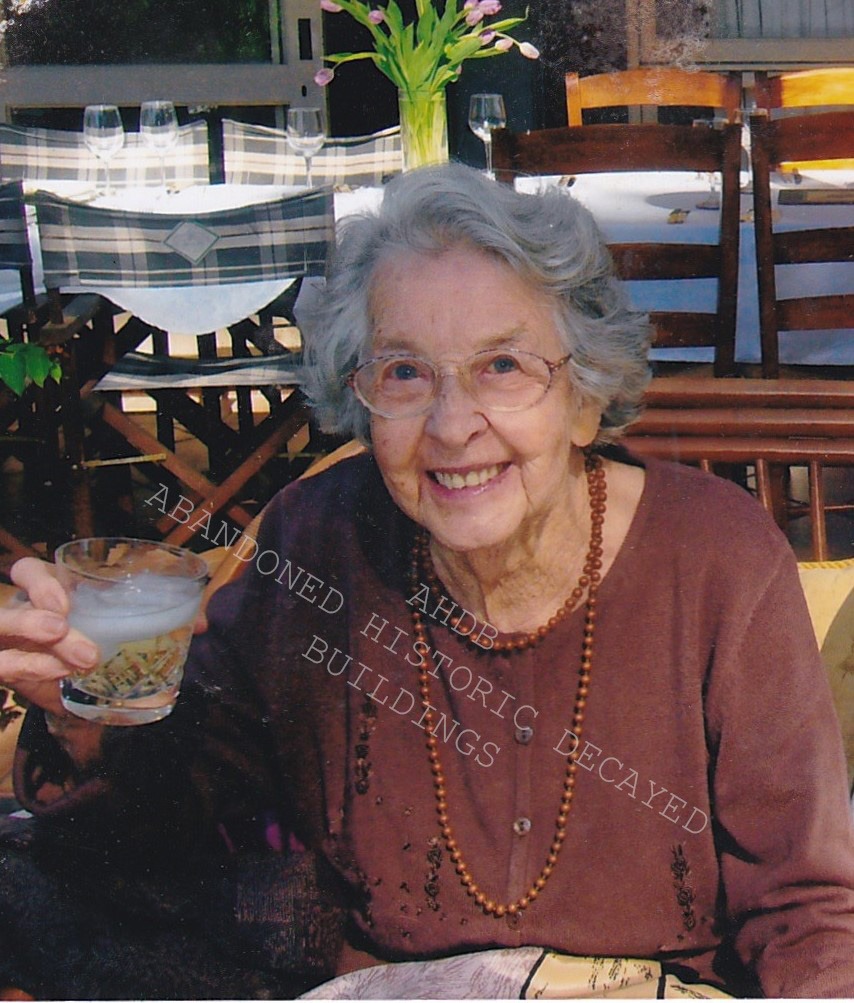
For years, it became home to Moira and George Cross. Formerly Moira Catherine Shannon, Mrs Cross is the daughter of Patrick William Shannon, a former member of the Land Court.
Mrs Cross was born in Wooloowin on 5 June 1916. She grew up there and studied at the All Hallows School in Fortitude Valley. Moira became part of many social events from dinners to charity events, given that her mother Annie was the President of the Past Pupils Association of All Hallows.
George and Moira signing the register after their wedding (Photo credit: National Library of Australia)
She married Geroge Cross in 1954 in a ceremony led by his half-brother, Reverend Father Neal Shannon.
Sadly, Moira lost his husband, George just years later after he died at war at 63 years old. Moira got to live until the age of 97. She passed away on 20 December 2013 and was buried at the Pinnaroo Lawn Cemetery and Crematorium at Bridgeman Downs where her sister Nuala was also buried.
After sitting empty for some time, the house was sold and then demolished in 2021.
Sam and Jesse Harrison, owners of the Facebook page AHDB – Abandoned, Historic, Decayed Buildings confirmed that they have collected and rescued various important family documents before the house was demolished. The documents have since been returned to family members.