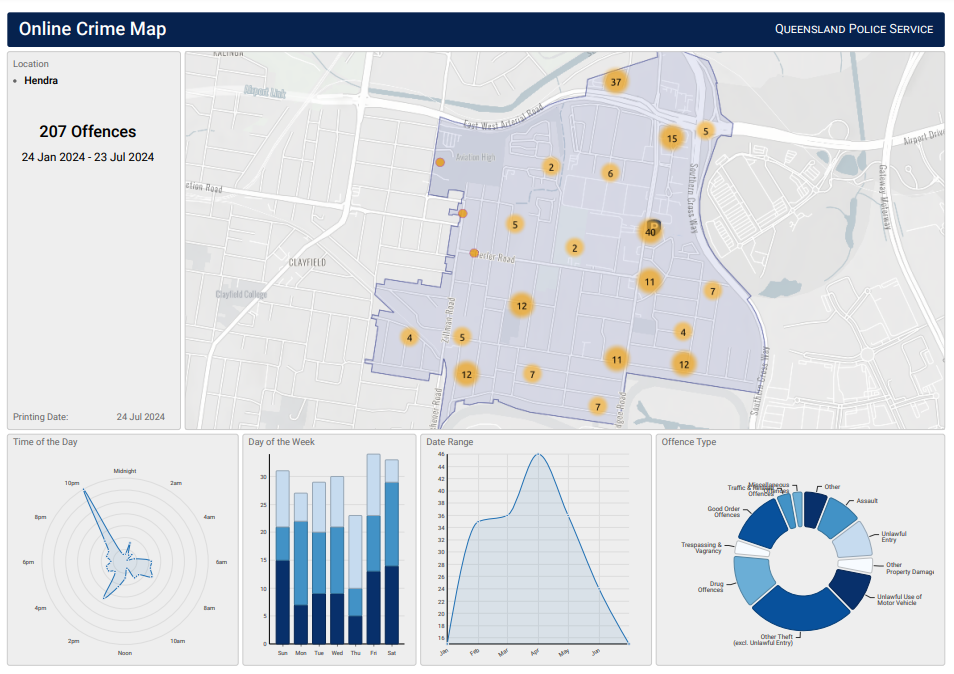
Based on the police data from 24 January to 23 July 2024, a total of 207 offences were recorded in the area, raising concerns among local residents and authorities alike.
The Online Crime Map, a tool used by Queensland Police to track and analyse crime patterns, showed 56 cases of theft reported during this period.
Photo credit: QPS Online Crime Map
Following closely behind are good order offences, accounting for 28 cases. While many of these are minor infractions such as consuming liquor in public places or going armed to cause fear, authorities warn that some instances can be more serious.
In a recent incident highlighting the ongoing crime issues in the area, Queensland Police charged two individuals in connection with an alleged break and enter at a Hendra residence. The event unfolded on Tuesday, July 16, when a vigilant neighbour spotted a suspicious man on CCTV walking alongside an elderly resident’s home on Mein Street.
Police quickly responded to the call and apprehended a 35-year-old woman from Zillmere, who was allegedly acting as a lookout. A 40-year-old man from Brighton was caught fleeing the scene with stolen property and drug paraphernalia. Both suspects are scheduled to appear in Brisbane Magistrates Court on August 19, facing multiple charges including trespass, burglary, and drug-related offences.
This recent break-in serves as a stark reminder of the ongoing challenges faced by law enforcement in the area. Local authorities are urging residents to remain vigilant and report any suspicious activities to help combat the rising crime rates in Hendra.
As the community grapples with these concerning statistics, questions arise about the factors contributing to the increase in criminal activity and what measures can be taken to ensure the safety and security of Hendra’s residents in the coming months.
A two-bedroom Clayfield unit at 1/78 Wagner Road sold for $660,000, attracting an unprecedented 24 registered bidders and exceeding the area’s median price for similar properties by a significant margin.
The 132-square-meter ground floor apartment, built in 1970, showcases the enduring appeal of Clayfield’s older housing stock. Known for spacious layouts and features like separate laundry rooms, these properties are increasingly sought-after in a market favouring quality and location.
Drew Davies of Place Ascot, who handled the sale with colleague Guy Horsley, noted the exceptional interest in the property. “It was the most registered bidders we’ve seen for a single auction in recent times,” Davies remarked, underscoring Clayfield’s current market heat.
The sale price represents a substantial increase from the $44,000 the previous owner paid 44 years ago, reflecting Clayfield’s long-term growth potential. More recently, the suburb has seen a 19% jump in median prices for two-bedroom units over the past year, reaching $545,000.
Clayfield’s proximity to Brisbane CBD — just 10 kilometres away — continues to be a major draw. The suburb is attracting a diverse range of buyers, from first-time homeowners to downsizers and investors, all vying for a piece of this desirable northside locale.
The strong result aligns with a broader trend in Clayfield and surrounding areas. “We’ve seen a huge surge in interest for apartments over the last year, especially for those in small blocks with low body corps in premium locations,” Davies explained, highlighting Clayfield’s particular appeal in this regard.
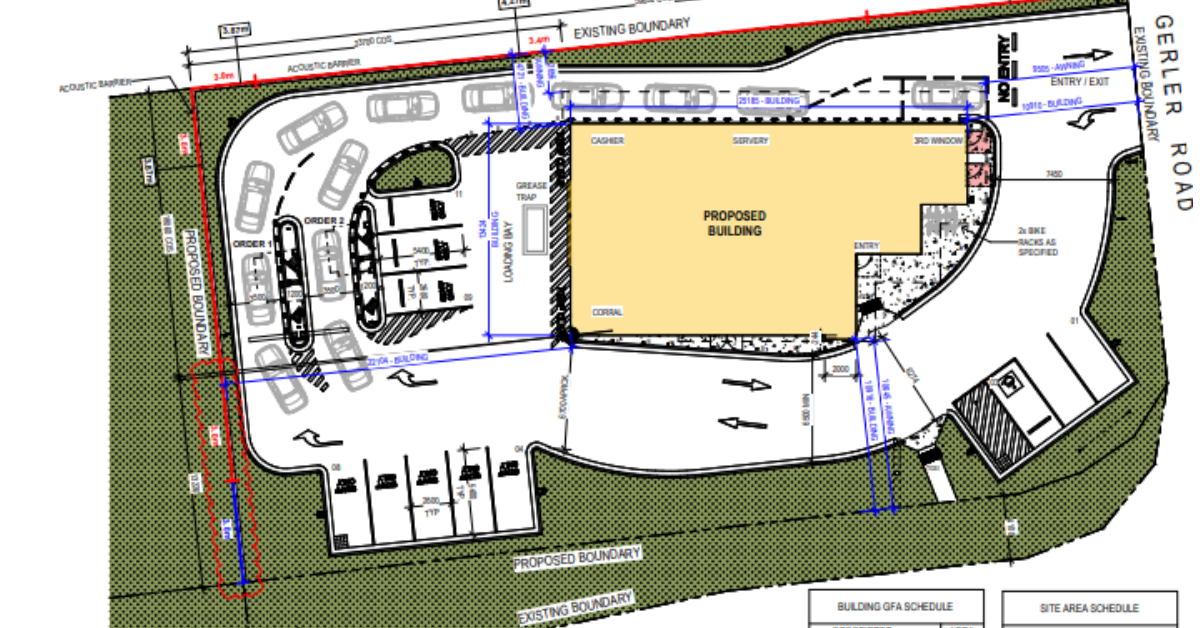
The application, submitted for the property at 330 Nudgee Road, details designs for a modern fast-food restaurant by PA Architects.
The 293-square-metre restaurant would occupy a 2,120-square-metre corner site, replacing the existing vehicle rental business and accessing both Nudgee and Gerler Roads. The development would include landscaping and an acoustic fence to minimise the impact on surrounding residential areas.
Urbis, the planning consultant for the project, argues that the proposal aligns with the area’s existing and historical land use. They emphasise that the development would not compromise the residential character of the neighbourhood or reduce the availability of residential land.
The proposal outlines a pedestrian pathway to the Nudgee Road footpath, ensuring accessibility for pedestrians and cyclists. The drive-through, designed with two lanes, is expected to accommodate 12 cars, aiming to streamline traffic flow and minimise congestion.
The development application is currently under review by the Brisbane City Council. Should it be approved, the new McDonald’s would join the existing Nudgee Service Centre location on Nudgee Road, further expanding the fast-food chain’s presence in the area.
For decades, the Kalinga Picture Palace, later known as the Star Theatre, was a hub of entertainment and community connection. Now, nearly a century after its inception, the theatre’s story is being pieced together, shedding light on its evolution and its role in the lives of locals.
The first documented mention of the theatre appeared in a 1920 electoral advertisement in the Daily Standard newspaper. It was initially an open-air venue known as the Kalinga Picture Palace, one of two locations hosting a political event that evening.
By 1926, the venue had been rechristened the Star Theatre. A few years later, in 1929, the Star underwent significant renovations, transitioning from an open-air cinema to a fully enclosed building with a roof. This improvement enhanced the viewing experience and allowed for year-round screenings.
The Talkies Arrive
In 1931, after a brief closure, the Star Theatre reopened with state-of-the-art RCA sound equipment. This marked a pivotal moment in the theatre’s history, as it could now screen “talkies,” or films with synchronised sound. This technological advancement attracted larger audiences and solidified the Star’s position as a premier entertainment destination.
The Star Theatre was more than just a place to watch movies. It served as a gathering point for the community, hosting events for local groups and schools. Kedron High School, for instance, is said to have used the theatre for children’s talent shows. This multi-faceted role made the Star Theatre a vital part of Kalinga’s social fabric.
An Untimely End
Sadly, the Star Theatre’s story came to an abrupt end in the early 1960s when a devastating fire destroyed the building. In its place, a service station was built, leaving behind only memories and a few scattered records of the theatre’s vibrant past.
Although the physical structure of the Star Theatre is long gone, its legacy lives on in the memories of those who experienced its magic. The story of the Kalinga Picture Palace and its transformation into the Star Theatre is a testament to the enduring power of cinema and its ability to bring communities together.
As historians and enthusiasts continue to uncover more details about this beloved venue, its importance in the history of Kalinga and Brisbane’s cinematic landscape becomes even clearer.
Three Clayfield schools have emerged as strong contenders in the latest rankings of Queensland’s top 150 high schools, according to an independent analysis by Better Education.
The 2023 rankings, based on Year 9 English and Maths results, reveal significant improvements for schools outside of Brisbane, with several making impressive strides.
Clayfield College on Gregory St is among the 19 new entries in the 2023 rankings, showcasing the growing academic strength of institutions outside the metropolitan area. The school placed alongside St Rita’s College on Enderley Rd, ranked at #28, and Aviation High School on Widdop St, ranked at #123.
Clayfield College is an independent, co-educational, Uniting Church Day, and boarding school. Established in 1931, it caters to students from preschool to Year 12. The college is known for its focus on academic excellence, pastoral care, and a wide range of co-curricular activities.
St Rita’s College is an independent, Roman Catholic, single-sex secondary school for girls. Founded in 1926 by the Presentation Sisters, it serves students from Years 7 to 12. The college emphasises academic achievement, faith formation, and social justice, offering a well-rounded education that prepares young women for leadership roles.
Aviation High School is a state secondary school that specializes in aviation-related studies. Established in 2010, it caters to students in Years 7 to 12 who are interested in pursuing careers in the aviation industry. The school offers a unique curriculum that combines academic subjects with practical training in aviation, aerospace engineering, and aeronautical science.
While the top four positions remain unchanged, with esteemed institutions such as the Queensland Academy for Science, Mathematics, and Technology and Brisbane Grammar School leading the pack, several schools have made notable climbs.
Somerville House and St Peters Lutheran College, both in Brisbane, each jumped four spots, securing fifth and sixth place, respectively. AB Paterson College on the Gold Coast also made a significant leap, rising nine places to break into the top 15.
Rank
School
Locality
Sector
State Overall Score
2022 Rank
1
Queensland Academy for Science, Mathematics and Technology
Toowong
Government
100
1
2
Brisbane Grammar School
Brisbane
Non-Government
100
2
3
Brisbane Girls Grammar School
Brisbane
Non-Government
100
3
4
Brisbane State High School
South Brisbane
Government
100
4
5
Somerville House
South Brisbane
Non-Government
100
9
6
St Peters Lutheran College
Indooroopilly
Non-Government
100
10
7
Somerset College
Mudgeeraba
Non-Government
100
5
8
Ormiston College
Ormiston
Non-Government
100
6
9
St Joseph’s College Gregory Terrace
Brisbane
Non-Government
99
11
10
Cannon Hill Anglican College
Cannon Hill
Non-Government
99
13
11
Whitsunday Anglican School
Beaconsfield
Non-Government
99
7
12
Anglican Church Grammar School (Churchie)
East Brisbane
Non-Government
99
15
13
AB Paterson College
Arundel
Non-Government
99
22
14
St Aidan’s Anglican Girls’ School
Corinda
Non-Government
99
8
15
All Hallows School
Brisbane
Non-Government
99
16
16
Emmanuel College
Carrara
Non-Government
99
24
17
St Margaret’s Anglican Girls School
Ascot
Non-Government
99
14
18
Ipswich Grammar School
Ipswich
Non-Government
99
12
19
Redeemer Lutheran College
Rochedale
Non-Government
99
21
20
Matthew Flinders Anglican College
Buderim
Non-Government
99
19
21
All Saints Anglican School
Merrimac
Non-Government
99
17
22
Hillbrook Anglican School
Enoggera
Non-Government
99
27
23
Mansfield State High School
Mansfield
Government
99
29
24
Citipointe Christian College
Carindale
Non-Government
98
34
25
Brisbane Boys’ College
Toowong
Non-Government
98
18
26
Sheldon College
Sheldon
Non-Government
98
23
27
John Paul College
Daisy Hill
Non-Government
98
31
28
Indooroopilly State High School
Indooroopilly
Government
98
35
29
Sunshine Coast Grammar School
Forest Glen
Non-Government
98
45
30
Mt St Michael’s College
Ashgrove
Non-Government
98
25
31
St Rita’s College
Clayfield
Non-Government
98
28
32
Northside Christian College
Everton Park
Non-Government
98
20
33
Immanuel Lutheran College
Buderim
Non-Government
98
69
34
Annandale Christian College
Annandale
Non-Government
98
74
35
Loreto College
Coorparoo
Non-Government
98
39
36
Stuartholme School
Toowong
Non-Government
98
44
37
Ipswich Girls’ Grammar School
East Ipswich
Non-Government
98
33
38
Padua College
Kedron
Non-Government
98
New Entry
39
St Andrew’s Anglican College
Peregian Springs
Non-Government
98
47
40
Moreton Bay College
Manly West
Non-Government
97
52
41
Marist College Ashgrove
Ashgrove
Non-Government
97
32
42
Kelvin Grove State College
Kelvin Grove
Government
97
48
43
Trinity Anglican School
White Rock
Non-Government
97
40
44
Brisbane South Secondary College
Dutton Park
Government
97
New Entry
45
St John’s Anglican College
Forest Lake
Non-Government
97
57
46
Mount Alvernia College
Kedron
Non-Government
97
41
47
Cavendish Road State High School
Holland Park
Government
97
46
48
Moreton Bay Boys College
Manly West
Non-Government
97
62
49
Townsville Grammar School
North Ward
Non-Government
97
26
50
Villanova College
Coorparoo
Non-Government
97
60
The rankings reveal that public schools are holding their own against some of the state’s most prestigious private institutions. Five public schools, including Mansfield State High and Indooroopilly State High, have secured positions within the top 50.
Regional schools have also demonstrated remarkable improvement. Annandale Christian College in Townsville, St Luke’s Anglican School in Bundaberg, and Tamborine Mountain State High School in the Scenic Rim have all made significant jumps in the rankings.
Other notable advancements include Immanuel Lutheran College on the Sunshine Coast, Springfield Anglican College in Ipswich, and St Andrew’s Lutheran College on the Gold Coast, all of which have climbed considerably in the rankings.
The 2023 list highlights the dynamic nature of Queensland’s educational landscape, with schools across the state striving for excellence. The inclusion of new entries and the impressive progress of numerous institutions signal a promising future for education in the region.
A 33-year-old Clayfield man has been arrested after allegedly breaking into a Bonney Avenue residence in Clayfield and stealing a black Mercedes Benz C250 Coupe in the early hours of May 6th.
According to Queensland Police Sergeant Jodie Murray, the man is accused of entering the home through an unlocked side door around midnight and taking cash, keys to the Mercedes, and other property from inside.
He then allegedly stole the luxury vehicle, with Queensland registration plates 511 ZZT, from the driveway before fleeing the scene.
Just over an hour later at 1:15 am, police reported locating the stolen Mercedes being driven suspiciously on Balmain Street in the nearby suburb of Wooloowin after members of the public reported the vehicle.
The 33-year-old Clayfield man was arrested and has been charged with entering a dwelling to commit an indictable offence, unlawful use of a motor vehicle, and obstructing police.
He is scheduled to appear before the Brisbane Magistrates Court on June 7th.
Alfred Lutwyche’s journey to becoming a prominent figure in Queensland was not without its trials. Before his legal career took off, he faced a life-altering ordeal—a shipwreck near the remote Amsterdam Island in the Southern Indian Ocean.
Lutwyche, along with his fellow passengers, found themselves stranded on this desolate island, stripped of their possessions and facing an uncertain future. The shipwreck was a test of resilience and survival, one that Lutwyche passed with flying colours.
The details of his survival and eventual rescue remain shrouded in some mystery. Still, the fact that he overcame this adversity and went on to achieve great things speaks volumes about his character and determination. This harrowing experience likely shaped his perspective and perhaps even fueled his ambition, ultimately leading him to play a pivotal role in the development of Kalinga and the legal landscape of Queensland.
Lutwyche’s story, much like the suburb he helped establish, is one of resilience, transformation, and enduring impact. Born in London in 1810, he embarked on a legal career that led him to Australia in the mid-19th century. But his journey was far from smooth sailing. His experiences due to the shipwreck stripped him of his possessions but not his determination.
Upon reaching Sydney, Lutwyche’s legal acumen quickly gained recognition. He was appointed Solicitor-General of New South Wales and later became Queensland’s first Supreme Court judge. Yet, his influence extended beyond the courtroom. He acquired vast tracts of land in the area now known as Kalinga, where he built his stately residence, Kedron Lodge.
Lutwyche’s vision for Kalinga was not merely residential. He envisioned a community anchored in faith and education. In 1865, he donated land for the construction of St. Andrew’s Anglican Church in Brisbane City, a landmark that still stands as a testament to his commitment to the spiritual well-being of the community. He also played a pivotal role in establishing the local school, ensuring that future generations would have access to quality education.
The judge’s legacy is not confined to bricks and mortar. His philanthropic spirit, his dedication to justice, and his unwavering belief in the potential of Kalinga continue to inspire residents. The suburb’s name itself, derived from the Aboriginal word “Kallingga,” meaning “good,” reflects the values Lutwyche instilled in this once-rural outpost.
Today, Kalinga is a thriving suburb, a blend of historical charm and modern amenities. Yet, beneath its contemporary facade lies the indelible mark of Alfred Lutwyche. His story is a reminder that Kalinga is not just a place on a map; it’s a living testament to the enduring power of vision, resilience, and community spirit.
EJ Station House, a unique restaurant and bar that presents a relaxed yet refined dining experience to both locals and visitors, has swiftly made its mark since its debut in February 2024.
The new hub specialising in wine, tapas & gelato bars is found in the lively communities of Eagle Junction, Wooloowin, and Clayfield. It has occupied the building that used to be Clayfield Grocery Store.
The exterior is covered with a basic black and white wooden colour. Upon entry, patrons are greeted by an inviting ambience, with soft lighting, wooden textures and greens in the pots. The place blends modern interior with rustic charm, perfect for chilling out during the day and family dinners at night.
Photo Credit: EJ Station House/Facebook
EJ Station House takes pride in its perfectly curated diverse menu that locals and visitors can come back to.
Customers have a variety of choices to choose from their menu including a few selections under bar tapas (made for small share plates) dishes like fried squid, grilled chorizo, baked sardines, and principales (designed for two), such as roast lamb shoulder, ribeye steak and many more to satisfy every plate.
The countless food selection encourages sharing, making it perfect for intimate gatherings or casual get-togethers with loved ones.
Complementing the food offerings is an extensive beverage list with wines, coffee, tea, smoothies, juices, milkshakes, cold beverages and even non-alcoholic beverages. Of course, they also have their house-made gelato for dessert.
EJ Station House provides a tranquil escape from the city hustle, inviting guests to unwind and relish in good food, fine wine, and delightful company that every local has to experience every once in a while.
Follow them on Facebook for opening hours, table booking and other updates.
Did you know that Rangemoor, a heritage-listed Robin Dods Queenslander, which represents a significant era in Clayfield’s architectural history, was recently sold for a remarkable sum of money? This transaction has not only set a new record for the suburb but has also caught the attention of locals and architectural enthusiasts alike.
In a carefully managed Top Offer campaign, Rangemoor was sold for an undisclosed amount after 30 days of intensive market activity.
This architectural masterpiece located at 165 Adelaide Street East, Clayfield was first built in 1907 and shows the influence of Brisbane’s first builder in its strong roofline, large verandas, and intricate woodwork.
Photo Credit: Website/Place New Farm
The house attracted huge bidder interest due to its prime location on one of Clayfield’s most recognized streets, its large block, and Brisbane’s architectural legacy.
The property’s deep historical roots and family-friendly atmosphere resonated with potential buyers, who were also drawn to the large grounds where kids could play.
Photo Credit: Website/Place New Farm
The house was designed to blend in. A central courtyard and single-level plan allow natural airflow and light into the apartments. When you enter, the formal and informal living areas blend smoothly. Beautiful French doors, 11-foot ceilings, and leadlight windows enhance the rooms.
Photo Credit: Website/Place New Farm
Sydney landscape designer Myles Baldwin’s 2018 plans for Rangemoor’s east and back gardens enhance the private suites’ luxury.
A young family looking for a legacy and home purchased Rangemoor. They value good schools and a safe environment for their children.
History of Rangemoor
In the late 19th century, John William Huggins Grout, initially a stockbroker in Brisbane, later became a prominent figure in the Queensland militia before moving to Dalby in 1900. He played a crucial role in forming the Dalby Company of the Queensland Mounted Infantry. Mr Grout returned to Brisbane in 1902, taking up various roles, including Vice-Consul for Spain.
During the early 1900s, Clayfield, along with its neighboring suburbs, emerged as prestigious addresses for the city’s elite families. In 1907, Mr Grout’s wife, Winifred, purchased an acre of land on Adelaide Street, where the renowned architectural firm Hall and Dods created “Rangemoor.”
Photo Credit: BCC
The Arts and Crafts and Art Nouveau movements had an impact on Mr Dods, an architect who improved Queensland’s traditional house design. His works in Clayfield/Ascot area include Lyndhurst and Turrawan, also known as the Clayfield House.
After Mr Grout died in 1918, the property changed hands, eventually being owned by Dr. Charles August Thelander, who chaired the controversial 1935-37 Royal Commission. Mr Thelander lived at Rangemoor until he died in 1959.
Over time, the property underwent alterations, including additions and subdivisions. Despite changes, much of Mr Dods’ original design remains, making Rangemoor a significant part of Adelaide Street East’s historical landscape.
At first glance, Wooden Horse restaurant in Clayfield looks unchanged as the same cosy cottage structure nestled into the neighbourhood. But inside, significant changes have upgraded this local favourite to fine dining destination under owners Chef Nick Alba and his wife Ruby.
Since they have taken over ownership, some changes have occurred transitioning it from neighbourhood favourite to fine dining destination. That’s because Chef Alba brings world-class experience to match the charming atmosphere.
Chef Alba and his wife met whilst both working in hospitality in 2014. As he trained under Gordon Ramsay in London and helped lead restaurants like Maze Grill, his hunger grew to one day run his own venue.
Chef Nick Alba and wife Ruby (Photo credit: woodenhorserestaurant.com.au)
The couple moved to New Zealand in 2016, allowing Chef Alba to further hone techniques in Nordic cuisine and contemporary European styles at some of New Zealand’s top eateries.
Photo credit: Wooden Horse Restaurant/Instagram
From there, Chef Alba’s distinct flair and ethos for ultra-fresh local ingredients took root. So when the couple returned to Australia in search of the perfect restaurant to make their mark on, they realised they already had a strong connection to their hometown gem after Alba grew up nearby and knew Clayfield well.
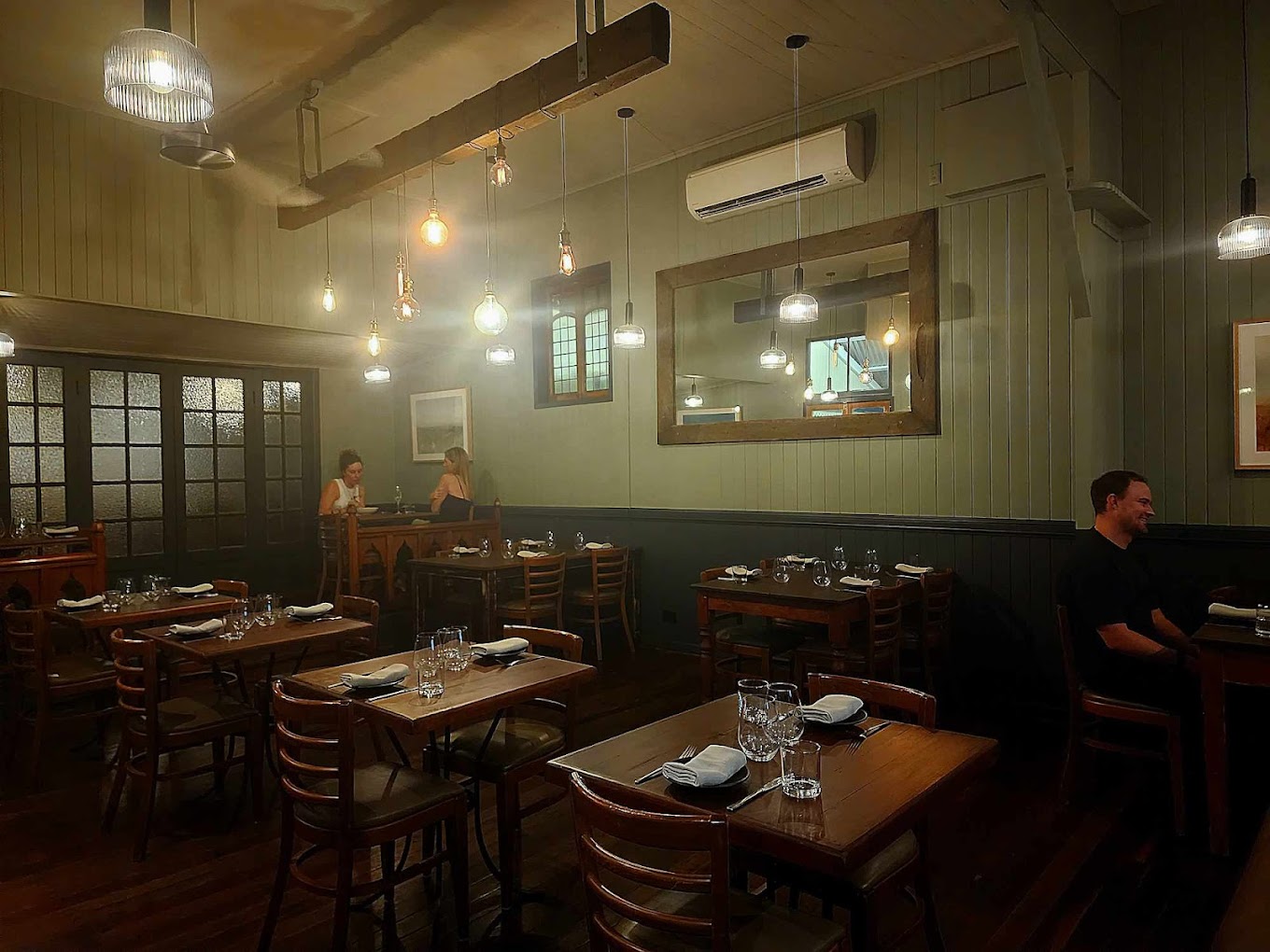
Photo credit: Zhuzhu Chen/Google Maps
Though Wooden Horse retained its quaint interior and warm service, Chef Alba has implemented the skills gathered across the globe into elevating the menu from reliable Mediterranean dishes to inventive degustation experiences with seasonal Australian ingredients as the stars. Diners now sample his takes on everything from smoked honey tarts to caramelised pork belly fresh out of the wood-fired oven.
Photo credit: Wooden Horse Restaurant/Instagram
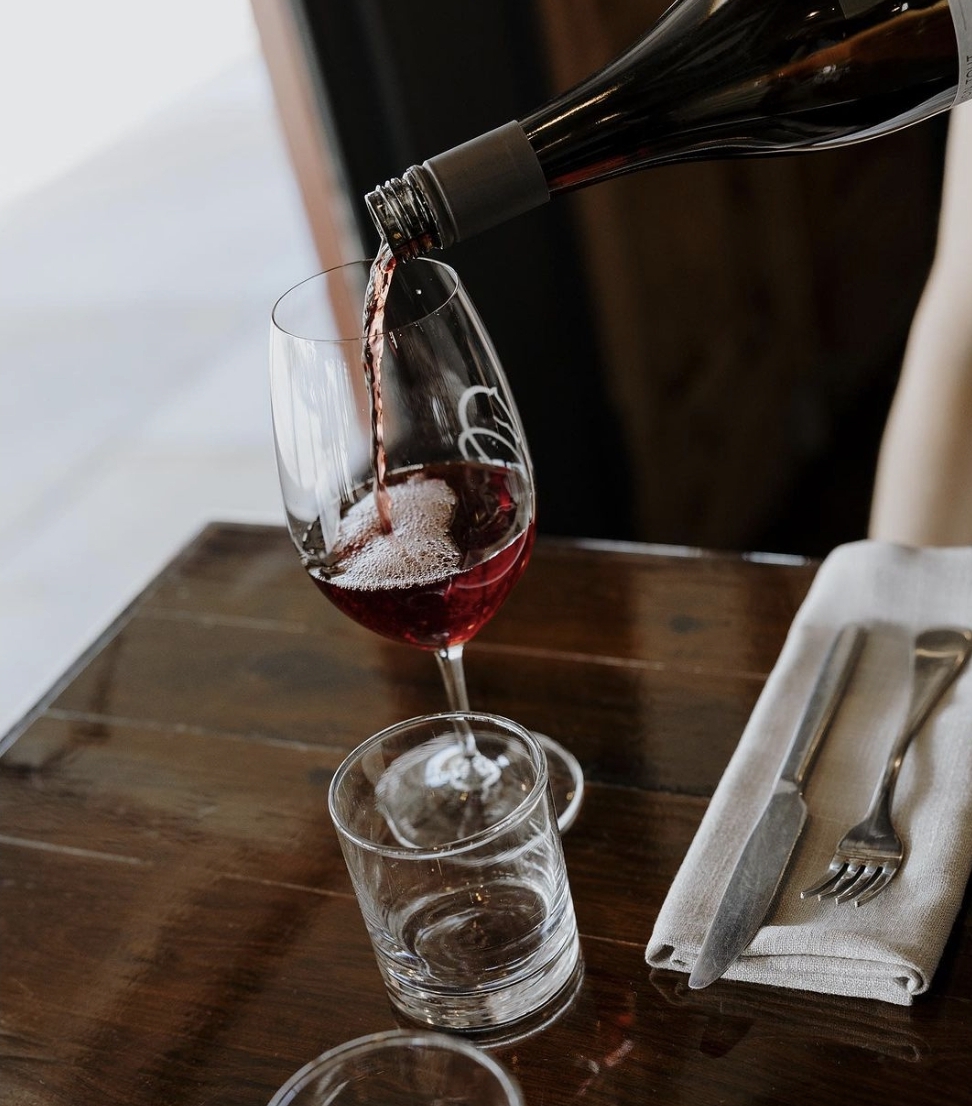
The Albas have also cultivated specialty cocktail and boutique wine lists to perfectly pair with the seasonal menu.
Photo credit: Wooden Horse Restaurant/Instagram
The neighbourhood cottage’s charm remains but it now offers cuisine on par with Brisbane’s top trendy establishments – and not simply because of technique but thanks to the new owners’ hospitality passions coming full circle.
From Maze Grill to New Zealand darling eateries and now to Clayfield, the journey has made Wooden Horse an even brighter light among the vibrant Brisbane dining scene.
Visit their website to learn more about their new fine dining menu.