Clayfield College student Ivy Lauder has just returned from her two-week stint at the Rafa Nadal Academy in Spain, as part of her winning the national finals of the 2021/22 Rafa Nadal Tour tournament.
Ivy Lauder has recently returned from the Rafa Nadal Academy in Spain as part of her winning at the Tournament’s Australian Masters Invitational for Girls 12/u event 2021/22 season held from 11 to 15 January 2022. She won against Zali Illitch in the final event (3-6, 4-6) with Scarlett Dattoli and Brooke Komorowski, taking third and fourth place, respectively.
Photo credit: Facebook / Clayfield College
Rafa_Nadal Tour is a nine-state premier event for juniors in the 12/u and 14/u held from April 2022 to January 2023. It is a junior tennis circuit that was launched in Spain in 2014 and has been running in Australia since 2019 in collaboration with the 22-time Grand Slam winner, Rafael Nadal.
The Rafa Nadal Tour focuses on sport and education, particularly the importance of sportsmanship, commitment, humility and resilience (updated fundamental values for 2022/23). With the Australian Tour, each state and territory event runs a Junior Gold Tournament.
The four winners from each 12/u and 14/u singles event and the four selected winners of the Trophy of Values progress to the end-of-circuit Australian Masters event. The Trophy Values are awarded to players who have shown on- and off-court positive attitudes and behaviour, and who live the Values of the Rafa Nadal Tour.
A maximum of 16 players are invited to compete in each of the 12/u and 14/u boys and girls Masters event. At stake were Rafa and Rafa Nadal Academy prizes including flights to Spain and two free weeks of training in Mallorca, Spain.
Kerbside Collection Day for Clayfield and nearby suburbs is fast approaching. Have you sorted your items for disposal yet? Here’s a list of acceptable and unacceptable items, and what to do with items that cannot be picked up.
furniture and white goods (e.g. fridges and stoves)
small household appliances (e.g. fans and toasters)
carpet and rugs
bath and laundry tubs
wood products less than 1.5 metres
bicycles and sporting equipment
electronic waste (e.g. televisions and computers)
The following items, however, should not be placed on the kerb during the collection period:
garden waste (e.g. trees, grass, potted plants)
dirt and stones
bricks and concrete
commercial builders waste
car parts and tyres, including car batteries
general household waste (e.g. food scraps)
liquids
hazardous wastes (e.g. chemicals, oil, asbestos)
gas bottles
glass and mirrors
household waste that normally goes into your waste or recycling bin
Bring them to resource recovery facilities
Brisbane City Council operates four resource recovery centres at Chandler, Ferny Grove, Nudgee and Willawong with recycling and waste facilities. You can drop them off for free or use your waste vouchers.
Printer cartridges are among the household waste that does not normally go into your waste or recycling bin.
If you have ink cartridges, you can bring them to Planet Ark, which turns the materials, such as plastics, metal, inks, and toners into new products. When they are disposed of into landfill, these resources are lost.
Photo credit: wolteeva/Pixabay
The Cartridges 4 Planet Ark program is an innovative recycling program that provides residents with an easy and environmentally accredited way to recycle their used printer cartridges.
Batteries, on the other hand, are among the top items commonly put on the kerb, even if they don’t belong there. Please remember that they cannot be disposed of in everyday household disposal bins or recycling bins.
Batteries should be brought to Aldi, Battery World, and selected Officeworks instead, where they will be properly recycled to prevent them from ending up in the landfill.
Photo credit: Visor69/Pixabay
Once the batteries are collected by specialists, they undergo sorting and separation into various grades, before they are processed into materials that can be used to manufacture new batteries or be used in the production of other steel products.
Just a tip before dropping off your batteries, tape the ends using non-conductive tape like electrical tape or sticky tape to prevent sparkling which creates fire hazards.
Photo credit: ds_30/Pixabay
Meanwhile, resource recovery centres also accept hazardous waste. Many of these hazardous waste are items at home, including bleach, garden chemicals, and cleaning solvents bought from supermarkets.
You can take advantage of the next free drop-off day at the Nudgee Resource Recovery Centre on Saturday, 3 December 2022, from 7:30 a.m. to 3:30 p.m. to drop off your household hazardous waste.
Did you know that the heritage-listed Clayfield House along London Rd first belonged to Dr. Arthur CF Halford, an esteemed obstetrician who wanted a house with a combined surgery facility to serve his patients?
In the early 1900s, it was common for doctors to manage a private hospital or clinic with surgery services from their homes, particularly for maternity cases. In keeping with the times, Dr Halford enlisted the help of Robin Dods, a prominent Brisbane architect, to design the residence/surgery building.
Mr Dods was quite familiar with Dr Halford’s requirements. His stepfather and brother were also doctors who managed a residence/surgery facility from their homes. The architect designed a similar concept for his brother’s place on Wickham Terrace.
Who was Dr Arthur CF Halford?
From 1906 to 1920, Dr Arthur Charles Frederick Halford conducted his medical practice from Turrawan, the other name he had for Clayfield House. He also had a clinic at 157 Wickham Terrace.
Dr Halford, the son of a professor, was born in Melbourne in 1869. Thirty years later, he was arranged to be married to Miss Nora Fitzgerald, whose family came from Cork, Ireland. The couple then settled in Rockhampton, Queensland after their wedding in 1899.
Photo Credit: National Library of Australia
By 1905, Dr Halford had bought an acre of land at the corner of Sandgate and London Rd to establish Clayfield House/Turrawan. The building’s original entrance faced Sandgate Rd for the residence whilst the surgery area was accessed via London Rd. Turrawan also had a tennis court at the back of the house.
In 1908, he was named the Honorary Assistant Physician at the Brisbane Hospital, where he pioneered a new method of treating burns and scalds by puncturing the blisters and cutting much of the affected skin. His method was adopted until the 1960s.
Photo Credit: Wikimedia Commons
What makes Clayfield House unique?
Clayfield House was built in a burgeoning prestigious residential area in North Brisbane. The design was efficiently thought out to separate the house from the surgery, with separate entrances and distinct room layouts. It became a shining example of the city’s medical practice development.
The size and quality of the doctor’s residence and surgery were uncommon during this period, especially since it has survived over decades. Some alternations were made to the house yet a lot of its original layout, details and characteristics remain today.
Photo Credit: Federationdetails.blogspot.com
Photo Credit: Federationdetails.blogspot.com
Turrawan demonstrated the history and development of the Queensland house, associated with the well-designed ideas of a prominent and influential architect.
After 1920, Clayfield House was let to Alexander Murray for five years then Dr Neville Sutton used London Rd as his professional address. Mr Dods is known for integrating British architectural concepts into traditional Queensland designs and materials.
Photo Credit: Federationdetails.blogspot.com
When Dr Halford’s wife died in 1932, parts of Clayfield House were sold, including a portion of the tennis court. After Dr Halford’s death in 1945, Savoy Pictures Pty Limited, which has built a theatre next to the property, bought the site.
Around 1960, Clayfield House was resurveyed and then subdivided into two blocks. BP Australia bought the first block on the corner and built a service station that operated for two decades.
On the other hand, the second lot became the property of Rodney and Colleen Abbott, who built a boarding house. Today, the facility is still known as Clayfield House, providing assisted living and supported accommodation.
Brisbane City Council reopened the park for the first time since February 2022, when it was closed due to fallen trees and debris.
Councillor Adam Allan joined locals in the reopening of the park on 27 August 2022, where there was face painting, a coffee van and a sausage sizzle.
Photo credit: Councillor Adam Allan/Facebook
Brisbane’s parks are slowly reopening as part of the city’s Rebuild and Recover program. As of July 2022, around 297 out of 1,072 damaged playgrounds are under repair, with only 15 remaining out of service.
Kalinga park was hard-hit by the severe weather earlier this year, leaving the play equipment and the BBQ as well as the brook damaged beyond recovery.
The park following the February 2022 flooding (Photo credit: Councillor Adam Allan/Facebook)
The first stage of the rebuild and recovery for Kalinga Park involved identifying what can be restored and removing what can’t whilst the second stage involved designing the layout for a playground that has greater flood resilience.
About Kalinga Park
Photo credit: Councillor Adam Allan/Facebook
A fixture in Kalinga since 1910, Kalinga Park (previously known as Anzac Memorial Park) is one of the most popular parks in the suburb because of its many facilities.
Located at 48 Kalinga Street, the park is equipped with playgrounds, picnic area/shelters, barbecue, basketball half court, bikeway, car park, cricket field, cultural heritage site, hockey fields, outdoor fitness/exercise trail, path network, public toilet, and tennis courts.
There’s an abundance of ‘superb strawbs’ from Stothart Family Farm in Moreton Bay and broccoli sourced from Windolf Farms in Lockyer Valley. There’s also plenty of carrots from Scenic Rim’s Kalfresh, corn from Mulgowie, and avocados from Balmoral Orchards in Toowoomba.
If you’re looking for easy recipes for these ingredients, here are 10 healthy and vibrant dishes you will love:
Vietnamese Style Prawn and Mango Salad
Photo supplied
A perfect spring taster, this salad recipe proves fruits and seafood can be a match made in heaven. Aside from these star ingredients, there are a few more goodness you can find here–cucumber, carrots, fresh herbs, and cherry tomatoes, all tossed with Vietnamese style dressing.
Ruby red grapefruit and beetroot salad with spiced salmon
Photo supplied
Give salad a refreshing twist by incorporating sweet beetroot, juicy ruby red grapefruit and spiced salmon fillet with your leafy greens. The yellow and red beetroot can be steamed in separate batches to ensure the red colour doesn’t run into the yellow.
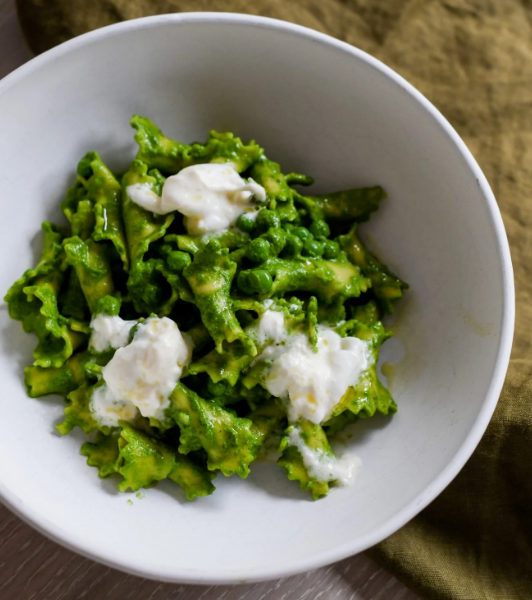
Making fresh campanelle is easier than you think. In this recipe, you’ll discover how to make your own campanelle pasta and make a healthy dish by adding some kale, garlic cloves, and baby peas.
These lemony poppy seed muffins are the perfect way to start the day in Spring. To make these muffins gluten-free, substitute the plain flour with blanched almond meal and gluten-free plain flour.
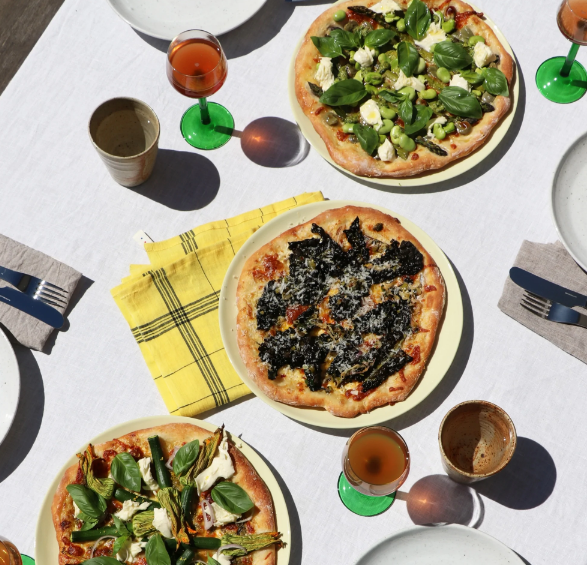
Pizza can be made healthier by adding some kale, asparagus, zucchini, and a bunch of basil on your toppings. Give it an extra flavour by adding some anchovies, crème fraiche, and mozzarella.
Barramundi Fajitas with Corn Salsa, Guacamole and Chipotle Mayo
Photo supplied
Fajitas is a classic Mexican dish and it’s made even more flavourful and vibrant with the addition of tomatoes, cucumber, and avocado. Make this light and smokey dish for dinner or even at your next party for a dish that’s sure to impress.
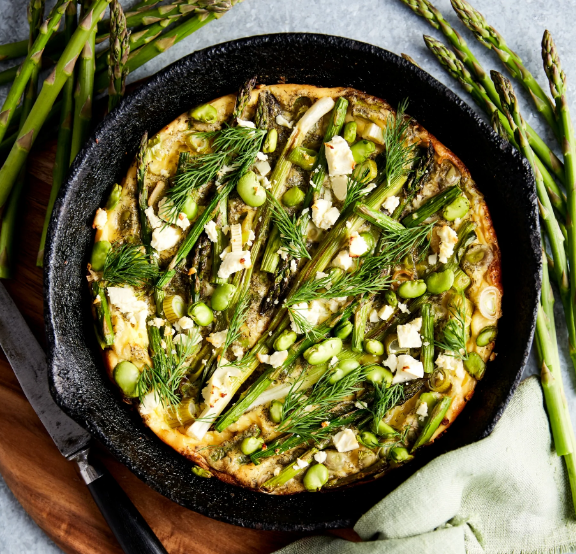
Loaded with wonderful spring greens and creamy Danish feta, this easy to make recipe can be a good option when you’re looking for a recipe to make for breakfast or an easy to make dinner.
This bright and fresh tofu dish is the ultimate quick dinner choice. Best served with warm rice, this stir-fry recipe is easy to make and can be divided into four bowls.
Slow Roasted Pork Belly with Fennel and Citrus Salad
Photo supplied
The juicy, slow roasted pork belly pairs perfectly with fennel and citrus salad, which combines oranges, grapefruit, fennel bulb, radicchio, long red chilli, red wine vinegar, and extra virgin olive oil.
A filling meal that’s sure to be a hit with the whole family, this recipe is loaded with green veggie goodness, tasty little chicken bites and golden hued basmati.
This season, Harris Farm Markets also shines the light on Imperfect Picks, which are seasonal ranges of fruits and vegetables that might not look perfect from the outside but are as perfect and full of flavour as ever on the inside.
Every time shoppers buy an Imperfect Pick, they are helping Harris Farm Markets take more from their farmers, they are helping reduce food wastage, and importantly, they are saving up to 50 per cent.
Harris Farm Market in Clayfield is open from 6:00 a.m. to 9:00 p.m. daily. Follow the Facebook page for more updates.
Starting from the Federation Era in the early 20th century, many of Brisbane’s prominent upper-middle-class families chose to build their finest, forever homes in Clayfield. Here’s a closer look at four heritage houses on Norman Parade that have been deemed historically significant to the development of Clayfield, as we know it today.
Bunburra
Charles Henry Day commissioned Eaton and Bates to design this ornate Federation-era house in 1902 when he purchased the land formerly owned by the Pettigrew family.
Mr Day was a wealthy commercial traveller who wanted a villa residence in the Eagle Junction area. He named the house Bunburra.
A few years later, Mr Day sold Bunburra to Katherine Peel and her husband Robert Sydney Frederick Peel. They were active in the organisation running the Clayfield Flower Show.
Photo Credit: National Library of Australia
The family lived in Bunburra until 1917. Since then, the stylish house has had several owners who retained its rare detailing and beautiful stained glass windows through the years.
As of 2021, Bunburra, on 18 Norman Parade, was valued at $1.3 million when it was sold to a new family.
Next door to Bunburra, on 22 Norman Parade, is another Federation-style house built for the family of Thomas Johnston, a contractor, around the same year as its neighbour. Generations of the Johnston family owned this property until the 1950s.
Photo Credit: National Library of Australia
The house was also named Moyola, as mentioned in the socials of the Brisbane Courier in 1913. Today, this house is estimated to be valued at $1.9 to $2.7 million.
Warehouse property manager Josiah Henry Peel had this residence built in 1906 on 26 Norman Parade. He and his wife named this house the Lycullin.
The Peels raised one son and three daughters in Lycullin, which became the scene for many social gatherings, as the Peels were among the prominent members of the Brisbane social set then.
Photo Credit: National Library of Australia
Mr Peel was well-known in the leather and grindery trade, where he was active for over 50 years. He was also one of the founders of the Commercial Travellers Association and a member of the illustrious Tattersalls’ Club. Originally from London, he was a keen gardener and avid motorist.
Lycullin was last sold to new owners in 2020 for $1.290 million.
Kilcreggan
Constructed around 1897, this Federation-style house on 51 Norman Parade, which was also known as Kilcreggan, was owned by David Graham Macfie who was the managing director of the Australian Mines Agency.
Later on, notable personalities like John Leahy and Frank McDonnell called Kilcreggan their home as well.
Mr Leahy was the Speaker of the House from 1907-1902. He also held prominent positions a the Queensland Meat Export Agency Co, the Australian Estates and Mortgage Company, and the Brisbane Chamber of Commerce.
Mr McDonnell founded McDonnell and East, a well-known department store in the CBD. He and his wife lived in Kilcreggan until his death in 1929.
Photo Credit: Google Maps
Today, Kilcreggan is known as The Residence, a retirement home.
More than 30,000 running red light incidents were recorded across Queensland as the Rose Street and Dawson Street intersection at Wooloowin ranks among the locations with the most infringement notices issued in 2021, the latest data revealed.
The latest Queensland Police Service data revealed the worst intersections for red lights running in 2021 with the Gold Coast Highway and Margaret Avenue at Broadbeach ranking first in the list.
“Ignoring a red light is one of the most dangerous decisions any driver can make and yet, on average, a motorist was caught running a red light every 17 minutes in Queensland last year,” RACQ Spokesperson Tristan Vorias said.
He added that the list revealed a disappointing reality that so many motorists are risking their own lives and the lives of others. A significant number of motorists were also “breaking the law” in regional Queensland, the data showed.
“You’re not only running the risk of crashing into other motorists, but also our most vulnerable road users like pedestrians and cyclists.”
Two intersections in Woolloongabba also made the list with Ipswich Road and Leopard Street intersections ranking second and fourth, respectively. The Ipswich Road intersection at Annerley (3rd spot) and the Rose Street intersection at Wooloowin round out the top five.
“The intersection of Moores Creek Road, High Street and Alexandra Street in Rockhampton caught 690 motorists running red lights, and the Bruce Highway and Coombs Street intersection in Cairns recorded 517,” Mr Vorias said.
“Already we’ve seen more than 160 people die on Queensland roads this year and we are tragically on track to surpass last year’s road toll.”
The following are the top 15 intersections with the most red-light camera infringement notices issued in Queensland in 2021:
Location
Number of Red Light Notices issued
Number of Notices per 1,000 Vehicles
Gold Coast Highway, Broadbeach. at i/s with Margaret Avenue
1,636
0.47
Ipswic Road, Woolloongabba, at i/s with Cornwall Street
1,547
0.4
Ipswich Road, Annerley, at i//s with Venner Road
1,194
0.18
Leopard Street, Woolloongabba, at i/s with Stanley Street
1,132
0.16
Rose Street, Wooloowin, at i/s with Dawson Street
1,038
0.81
Gold Coast Highway, Tugun, at i/s with Stewart Road
901
0.26
Kingston Road, Waterford West, at i/s with Muchow Road
901
0.26
Kumbari Avenue, Southport, at i/s with Smith Street
825
0.37
Strathpine Road, Bald Hills, at i/s with Bald Hills Road
704
0.15
Lutwyche Road, Luwyche, at i/s with Norman Street/Perry Street
696
0.09
Moores Creek Road, Park Avenue (Rockhampton) at i/s with Hight Street/Alexandra Street
690
0.18
Duke Street, Annerley, at i/s with Juliette Street
632
0.16
Lutwyche Road, Kedron, at i/s with Kedron Park Road (Lanes 1, 2 and 3)
568
0.07
Beaudesert Road, Calamvale, at i/s with Compton Road
535
0.09
Bruce Highway, Mt Sheridan (Cairns), at i/s with Coombs Street
517
0.08
Source: RACQ
“Motorists need to stop risking lives just to save a few seconds. They need to be prepared to slow or stop when approaching traffic signals and treat yellow lights as though they are red,” Mr Vorias concludes.
‘Strong enrolment demand’ from local families has led Brisbane independent school Clayfield College to add an extra class in each Year level from Prep to Year 5, starting 2023.
College Principal, Dr. Andrew Cousins, said they already have families on waiting lists for these Years, and with continued strong enquiry levels and demand for their tours, they felt it was the right time to announce the increase and allow families time to plan their educational arrangements for 2023.
The additional classes are just among the big changes coming to the college, after it announced plans to transition as fully co-educational (Pre-Prep to Year 12).
At present, Clayfield College is co-educational from Pre-Prep to Year 6, and girls only from Years 7 to 12.
Boys will be added to the Secondary School one cohort at a time until the College is fully co-educational in 2027.
The transition will be done using the Parallel Learning Model, which combines the advantages of single sex and co-educational education.
The learning model promises the “best of both worlds” because it allows for gender-specific teaching when it matters most, with all the social benefits of a co-educational campus.
“For some years and across multiple surveys and feedback forums, parents have asked the College to become fully co-educational because it would better suit their families,” the school stated in its website.
From 2023, Year 7 students will begin single-sex learning streams, continuing through Years 8 and 9. In Year 10, students come together for selected classes and then benefit from fully co-educational classes in Years 11 and 12.
“Families are appreciating the opportunity for a co-educational offering at one of Brisbane’s finest schools, and with an enviable heritage and a bright, innovative future, Clayfield is well placed to truly offer an exceptional educational experience,” Dr. Cousins said.
Behind the Toombul Shopping Centre, one can find what used to be the site of the Zion Hill mission, a small hilly area where fellowship and worship in a small, wooden house eventually gave birth to the Clayfield Baptist Church.
Zion Hill was regarded as the German Station in the 1860s. From slab huts to conduct their worship and work, the German missionaries built a small house where they had bible classes, meetings, and worships in English and German.
The Clayfield Baptist Church was established by German settlers who wanted to grow Christianity and expand its missionary work in the colony. Before it was known as the Clayfield Baptist Church, the church was called the Hendra Baptist Church.
Fifteen years after its establishment, the chapel was moved to Alexandra Rd, where the present Clayfield Baptist Church has thrived, fulfilling its mission for more than 170 years.
Friedrich Theodor Franz, Owner of the Clayfield Land
Alexandra Rd in Clayfield was a farm owned by Friedrich Theodor Franz, also known as Karl or Charles Theodor Franz, who was originally from Pomerania in Central Europe and was a tailor by trade. He was still a bachelor when he joined Zion Hill, where he met and married Caroline Schneider, the widow of Moritz Schneider.
Mr Franz acquired substantial properties in that part of North Brisbane and built a house along Best St in Hendra in the 1850s. He named the house Heimat, the German word for “home.”
The house still stands on the location but has been converted into four flats.
Mr Franz eventually donated Alexandra Rd to the Clayfield Baptist Church. This small chapel would serve the community for many years until the community had to build a new church as its members increased.
He died in 1891 and was recognised for his civic work. Clayfield’s Franz Road was named after him.
In 1891, a new building was built next to the old chapel. Designed by architect A. Robertson, the building was a Pointed Gothic structure with coloured glass windows.
The old building was retained as a classroom for Sunday school services. In 1966, however, the original wooden chapel was dismantled and replaced with a brick building.
The church incurred debts due to the construction of the new building. Unperturbed, the outreach ministry didn’t stop soliciting support and many responded. Attendance, as well as baptisms, increased.
The First World War was a difficult time for many members of the church, Many people lost loved ones and friends. Presents and other tokens were sent by the church to those on the frontlines.
In the 1920s, there were over 125 kids attending Sunday school but attendance gradually declined for the next 15 years. Membership also eventually trickled down to under 40 individuals.
During the Second World war, a proposal was raised to sell the land but this wasn’t pursued. Two decades later, membership increased to the present norm of about 70 individuals. Extensions to the building were built.
By the 1980s, the Pointed Gothic building had become unsafe due to storm damage and pest control issues. It was demolished and replaced with the brick building that stands there today.
The management announced the permanent closure on social media, leaving some followers wondering why it’s so sudden.
“You know what s***s? Goodbyes. So what I’m going to say instead is this is the very last day you can eat Wing Fury as it’s closing its doors,” the Facebook post reads.
“It has been amazing. It’s not you, it’s us.”
Photo credit: Wing Fury/Facebook
In a radio interview with 4BC, owner Sam explained that the cost of products just kept rising to a point she couldn’t pass on to customers. She said it seems unfair to charge people a premium cost when it’s only because of food shortages.
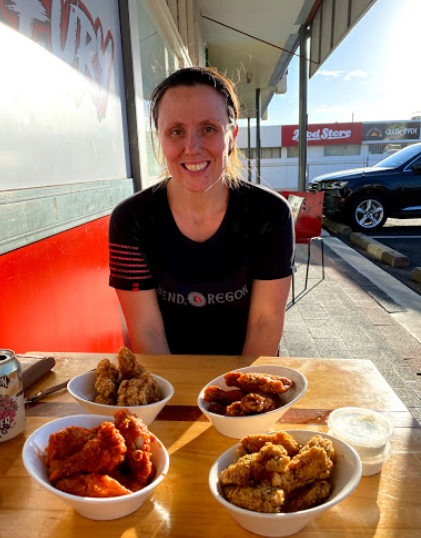
Located along Junction Road, Wing Fury was once the go-to for heavenly chicken wings. The crunchy coating and the sauce, which is packed with flavour, kept people coming back. They also had gluten-free options for healthy eaters.
Photo credit: Wing Fury/Facebook
The announcement left some customers sad, including Matthias, one of their patrons, who would even drive all the way from Burpengary for the honey buffalo wings.
“Your shop is our go-to place for yummy chicken wings and pizza. Our Friday movie nights dinner will be a bit boring now,” said Grace.
“NEED the honey mustard and sticky Vietnamese recipes. Literally drive and wait hours for your wings some nights, don’t think we will ever find any as good anywhere else,” wrote Chanelle.
Photo credit: Justine Meade/Google Maps
“Sad news. I used to come 30min to get wings and pizza because you made the best, and possibly only, gluten-free wings in Brisbane. I wish you the best for the future, and hope one day you might share your gluten-free crumb recipe,” Graham commented on the post.
As for the ‘secret’ sauce recipes, the owner would either keep them or pass them down to her family for generations.