A man who attempted to break into a secure car park next to a residential building in Wolseley St, Clayfield in October 2022 was arrested by authorities, thanks to a resident who immediately reported the incident.
The resident took careful note of the man’s appearance and movements, and quickly notified police with a clear description. Police then arrived at Wolseley St, where they located and arrested a man matching the description provided.
The man, who allegedly possessed house-breaking implements, was charged with attempted enter premises and commit indictable offence, possession of house breaking materials and possession of tainted property. He will next appear in Brisbane Magistrates Court on 15 November 2022.
Photo credit: Kindel Media/Pexels
Based on Queensland Police Service’s Online Crime Map, unlawful entry is among the leading types of offence in Clayfield.
During the last quarter (13 September – 12 December 2022), there were a total of 48 cases of Unlawful Entry, which mostly took place between 10:00 p.m. and 6:00 a.m.
What to Do When You Witness A Crime
Photo credit: Anna Shvets/Pexels
Queensland Police advises members of the public to write down what they see as soon as possible and keep a record of the date and time of their observations as this can be important if they are required to give a statement to the police.
If you see a crime being committed, follow these steps:
When safe to do so, contact police
Keep calm and give your name, address and telephone number
Report what is happening and where
Stay on the phone
If you can safely do so, keep watching and continue to report what is happening.
It is important to try to build a complete picture of the person from head to toe, paying particular note of the features, such as the gender and age bracket, body frame and size, haircut and colour, clothing, and any distinguishing features such as scars, tattoos, or glasses.
The new Eagle Junction State School Early Years Precinct is officially open. Nearly $9 million has been poured into the 127-year-old state school for ten new classrooms, an astro-turfed play area, and a new playground.
The newly opened early years’ precinct for Eagle Junction State School features a learning centre, artificial turf area and playground. Present at the ceremony held last 16 November 2022 were Education Minister Grace Grace, Principal Adam Mathewson and P&C President Jo Senz.
“These state-of-the-art facilities are giving Eagle Junction’s Prep and Year 1 students the best possible start to their state school education,” Ms Grace said.
The new Early Years Precinct contains ten new classrooms including five specially designed for Preppies, a new staff planning and resource preparation area, two practical outdoor learning areas, student and staff amenities and an accessible covered walkway to serve as the precinct’s link to the rest of the school. There is also an artificial turf area and playground with climbing equipment, slides and a sandpit.
“This development supported 20 good jobs over the life of the project, with 11 apprentices working on site throughout construction learning trades that will set them up for life.”
Eagle Junction State School Principal Adam Mathewson welcomed the opening of the new precinct which supports the school’s “visible” learning educational approach.
(L-R) Principal Adam Mathewson, Education Minister Grace Grace, School Vice-captains Jessica Sanfilippo and Oliver Senz, School Captains Elodie Whitaker and Finn Latimer, P&C President Jo Senz | Photo credit: Facebook / Grace Grace MP
“We want students to know how to learn, not just what to learn. At EJ, we encourage students to actively participate in their learning and the new early learning precinct offers modern, new and flexible facilities to do just that,” Mr Mathewson said.
“We are purposeful in encouraging collaboration where students not only teach themselves, but learn alongside their peers and have the opportunity to compare their work with visible examples which help them identify ways in which to learn and grow.
“Our students can articulate their learning journey, how they are going with their learning, and what steps they need to take next, to achieve their learning goals.”
Opened in 1895, Eagle Junction State School caters to students from the preparatory year to year 6. The current population stands at over 900 students.
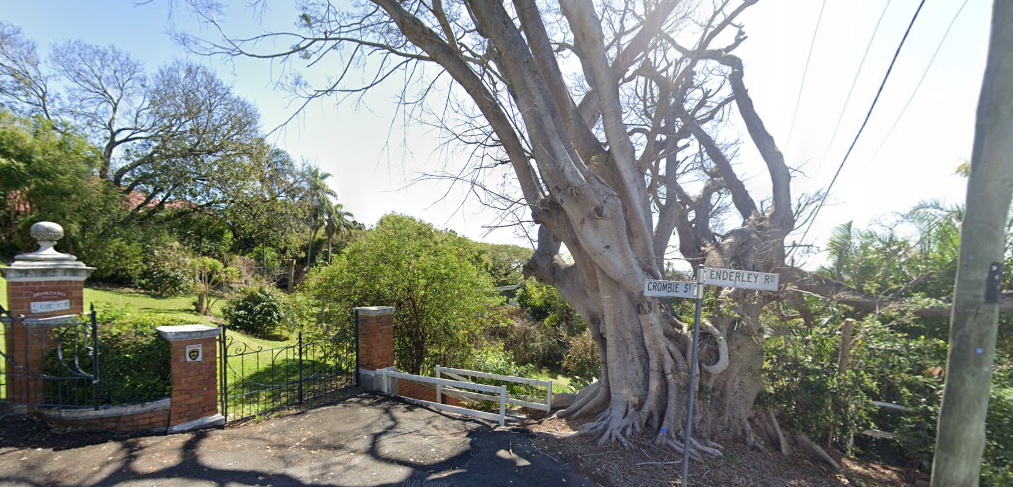
This comes after nearby residents noticed that the Moreton bay fig tree, located at the corner of Crombie Street and Enderley Road, has been experiencing a sudden decline, and has been looking unhealthy since last 2021.
A resident, who wishes to be unanimous, claimed that nature officers examined the soil and though official results were not shared, allegedly found herbicide residues.
Whilst neighbours believe the tree had been poisoned, an arborist refuted such claims and said the tree looks like they have dead leaves that haven’t dropped off, which isn’t an indication of herbicide damage.
When a tree is poisoned, the arborist said, the leaves suddenly fall. If it’s confirmed to be a case of poisoning, the arborist from Brisbane Trees and Gardens assured it can still be saved, since most poisons are biodegradable. Normally, flushing the soil is an effective measure.
Photo credit: Google Street View
Regarding the issue, City Standards Chair Kim Marx stated that any interference with the trees was unacceptable and would not be tolerated.
Under the Brisbane City Council’s Natural Assets Local Law 2003, natural assets including bushland areas, wetlands, waterway corridors and trees in urban areas should be protected.
Marx said Council is working to save the Moreton Bay fig tree, by trimming it and using specialised techniques to get rid of the herbicide from the soil. Council officers will also closely monitor the tree.
Meanwhile, a sign will be placed in the area asking the community to provide information to help them find those responsible. Residents can report interference with protected vegetation online if they suspect vegetation has been cleared or damaged unlawfully.
For more than a century, St Agatha’s Catholic Church has had a strong spiritual, social and cultural impact in the Clayfield community, marking its special ties to the expansion of the Catholic faith in Brisbane.
During World War I, Clayfield locals expressed to Brisbane Archibishop James Duhig their need to establish a Catholic Church in the area despite the presence of other churches in Wooloowin, Nundah, and Hamilton.
The influential archbishop proceeded to buy three acres of sloping land along Oriel Road in 1917 from Mr J B Charlton, with the intention of building a mass centre and a school. Mr Ernest Taylor won the tender for the project to build the church, which kickstarted in 1918. The archbishop blessed the foundation stone on the site and by September of that same year, the place of worship, which had a wooden structure, was also blessed and opened to the devoted Catholic community.
Archbishop Duhig chose the name St Agatha’s after the patron saint of the sixth-century church attached to the Irish College in Rome, where he received his education. He tasked Father Richard Walsh to celebrate a regular Sunday mass, and sometimes weekday morning worships, at this church.
By 1924, St Agatha’s Catholic Church received major building improvements as funded by the Clayfield community, where some of the more elite residents of Brisbane lived. Among its important donors were Hennessy and Hennessy and Mrs T.C. Beirne.
1925: New Building for St Agatha’s Catholic Church under Father O’Connell
Rev. Father Francis O’Connell was officially the first parish priest of St Agatha’s, who arrived in Clayfield in 1921. He was instrumental in the construction of the new Romanesque-style polychromatic brick church, which cost £10,000 and was designed by architect Jack P. Donoghue or J.P. Donoghue.
At the opening of the new church, Father O’Connell exclaimed that he was certain Mr Donohue will long be remembered for his work after seeing the beautiful church, especially among the builders of the future. The building, with its striking design, has become an iconic visual presence on Oriel Road.
The site of the new church was in the quiet, elevated portion of Oriel Road next to Stanley Hall. Father O’Connell lived in a presbytery built before the church building was completed.
The old wooden church was transformed into a school with Father O’Connell, along with Archbishop Duhig, convincing the Presentation Sisters to come to Clayfield and run the institution, which would eventually become St Rita’s College. The school officially opened in January 1925 with 120 students. By the next year, the student population doubled but the institution was big enough to accommodate 500 kids.
Father O’Connell served as a parish priest until his sudden death in 1939 at 49 years old.
St Agatha’s Catholic Church’s Other Notable Priests
Apart from Father O’Connell, St Agatha’s Catholic Church welcomed around six more parish priests in its 100 years, each serving the Clayfield community for more than a decade.
1940-1968: Rev Monsignor John English became the parish priest after Father Frank’s death and was behind the additions to the church building, such as the large domed sanctuary and sacristy, the altar boys’ room, and the side chapels. He was popular with the community but was known to be forthright with his observations and dislikes.
1968-1989: After Monsignor John English died, Rev Father Vincent Rowan assumed as parish priest and had a challenging time implementing massive changes in the Catholic Church as ordered by the Second Vatican Council. During his time, Father Rowan oversaw the construction of a new school building replacing the wooden structure and formed the Parish Pastoral Council and Clayfield Care. He retired from his duties after suffering a stroke.
1989-1998: Father Bernard Wilson initiated a number of programs for St Agatha’s Catholic Church, extending beyond the children’s education. He established eucharistic and music ministries, as well as formed the Financial Council. He organised a pilgrimage to the Holy Land but was unable to join the actual trip due to an accident. During his time, renovations and upgrades were done to the aging church building.
1998-2015: Very Rev Dr Adrian Farrelly wasn’t named the parish priest but the administrator of St Agatha’s Catholic Church. He was revered for his sermons and believed that St Agatha’s must remain a strong community.
2015-2018: Fr Anthony Mellor was the administrator in several other churches before his assignment in Clayfield. He was in Ashgrove, Bardon, Birkdale, Hendra, Herston, Newmarket, Red Hill, Rosalie and Victoria Point. He also helped in The Gap parish.
The current parish priest is Fr Biju Thomas who took on his duties in 2020.
Clayfield College student Ivy Lauder has just returned from her two-week stint at the Rafa Nadal Academy in Spain, as part of her winning the national finals of the 2021/22 Rafa Nadal Tour tournament.
Ivy Lauder has recently returned from the Rafa Nadal Academy in Spain as part of her winning at the Tournament’s Australian Masters Invitational for Girls 12/u event 2021/22 season held from 11 to 15 January 2022. She won against Zali Illitch in the final event (3-6, 4-6) with Scarlett Dattoli and Brooke Komorowski, taking third and fourth place, respectively.
Photo credit: Facebook / Clayfield College
Rafa_Nadal Tour is a nine-state premier event for juniors in the 12/u and 14/u held from April 2022 to January 2023. It is a junior tennis circuit that was launched in Spain in 2014 and has been running in Australia since 2019 in collaboration with the 22-time Grand Slam winner, Rafael Nadal.
The Rafa Nadal Tour focuses on sport and education, particularly the importance of sportsmanship, commitment, humility and resilience (updated fundamental values for 2022/23). With the Australian Tour, each state and territory event runs a Junior Gold Tournament.
The four winners from each 12/u and 14/u singles event and the four selected winners of the Trophy of Values progress to the end-of-circuit Australian Masters event. The Trophy Values are awarded to players who have shown on- and off-court positive attitudes and behaviour, and who live the Values of the Rafa Nadal Tour.
A maximum of 16 players are invited to compete in each of the 12/u and 14/u boys and girls Masters event. At stake were Rafa and Rafa Nadal Academy prizes including flights to Spain and two free weeks of training in Mallorca, Spain.
Kerbside Collection Day for Clayfield and nearby suburbs is fast approaching. Have you sorted your items for disposal yet? Here’s a list of acceptable and unacceptable items, and what to do with items that cannot be picked up.
furniture and white goods (e.g. fridges and stoves)
small household appliances (e.g. fans and toasters)
carpet and rugs
bath and laundry tubs
wood products less than 1.5 metres
bicycles and sporting equipment
electronic waste (e.g. televisions and computers)
The following items, however, should not be placed on the kerb during the collection period:
garden waste (e.g. trees, grass, potted plants)
dirt and stones
bricks and concrete
commercial builders waste
car parts and tyres, including car batteries
general household waste (e.g. food scraps)
liquids
hazardous wastes (e.g. chemicals, oil, asbestos)
gas bottles
glass and mirrors
household waste that normally goes into your waste or recycling bin
Bring them to resource recovery facilities
Brisbane City Council operates four resource recovery centres at Chandler, Ferny Grove, Nudgee and Willawong with recycling and waste facilities. You can drop them off for free or use your waste vouchers.
Printer cartridges are among the household waste that does not normally go into your waste or recycling bin.
If you have ink cartridges, you can bring them to Planet Ark, which turns the materials, such as plastics, metal, inks, and toners into new products. When they are disposed of into landfill, these resources are lost.
Photo credit: wolteeva/Pixabay
The Cartridges 4 Planet Ark program is an innovative recycling program that provides residents with an easy and environmentally accredited way to recycle their used printer cartridges.
Batteries, on the other hand, are among the top items commonly put on the kerb, even if they don’t belong there. Please remember that they cannot be disposed of in everyday household disposal bins or recycling bins.
Batteries should be brought to Aldi, Battery World, and selected Officeworks instead, where they will be properly recycled to prevent them from ending up in the landfill.
Photo credit: Visor69/Pixabay
Once the batteries are collected by specialists, they undergo sorting and separation into various grades, before they are processed into materials that can be used to manufacture new batteries or be used in the production of other steel products.
Just a tip before dropping off your batteries, tape the ends using non-conductive tape like electrical tape or sticky tape to prevent sparkling which creates fire hazards.
Photo credit: ds_30/Pixabay
Meanwhile, resource recovery centres also accept hazardous waste. Many of these hazardous waste are items at home, including bleach, garden chemicals, and cleaning solvents bought from supermarkets.
You can take advantage of the next free drop-off day at the Nudgee Resource Recovery Centre on Saturday, 3 December 2022, from 7:30 a.m. to 3:30 p.m. to drop off your household hazardous waste.
Did you know that the heritage-listed Clayfield House along London Rd first belonged to Dr. Arthur CF Halford, an esteemed obstetrician who wanted a house with a combined surgery facility to serve his patients?
In the early 1900s, it was common for doctors to manage a private hospital or clinic with surgery services from their homes, particularly for maternity cases. In keeping with the times, Dr Halford enlisted the help of Robin Dods, a prominent Brisbane architect, to design the residence/surgery building.
Mr Dods was quite familiar with Dr Halford’s requirements. His stepfather and brother were also doctors who managed a residence/surgery facility from their homes. The architect designed a similar concept for his brother’s place on Wickham Terrace.
Who was Dr Arthur CF Halford?
From 1906 to 1920, Dr Arthur Charles Frederick Halford conducted his medical practice from Turrawan, the other name he had for Clayfield House. He also had a clinic at 157 Wickham Terrace.
Dr Halford, the son of a professor, was born in Melbourne in 1869. Thirty years later, he was arranged to be married to Miss Nora Fitzgerald, whose family came from Cork, Ireland. The couple then settled in Rockhampton, Queensland after their wedding in 1899.
Photo Credit: National Library of Australia
By 1905, Dr Halford had bought an acre of land at the corner of Sandgate and London Rd to establish Clayfield House/Turrawan. The building’s original entrance faced Sandgate Rd for the residence whilst the surgery area was accessed via London Rd. Turrawan also had a tennis court at the back of the house.
In 1908, he was named the Honorary Assistant Physician at the Brisbane Hospital, where he pioneered a new method of treating burns and scalds by puncturing the blisters and cutting much of the affected skin. His method was adopted until the 1960s.
Photo Credit: Wikimedia Commons
What makes Clayfield House unique?
Clayfield House was built in a burgeoning prestigious residential area in North Brisbane. The design was efficiently thought out to separate the house from the surgery, with separate entrances and distinct room layouts. It became a shining example of the city’s medical practice development.
The size and quality of the doctor’s residence and surgery were uncommon during this period, especially since it has survived over decades. Some alternations were made to the house yet a lot of its original layout, details and characteristics remain today.
Photo Credit: Federationdetails.blogspot.com
Photo Credit: Federationdetails.blogspot.com
Turrawan demonstrated the history and development of the Queensland house, associated with the well-designed ideas of a prominent and influential architect.
After 1920, Clayfield House was let to Alexander Murray for five years then Dr Neville Sutton used London Rd as his professional address. Mr Dods is known for integrating British architectural concepts into traditional Queensland designs and materials.
Photo Credit: Federationdetails.blogspot.com
When Dr Halford’s wife died in 1932, parts of Clayfield House were sold, including a portion of the tennis court. After Dr Halford’s death in 1945, Savoy Pictures Pty Limited, which has built a theatre next to the property, bought the site.
Around 1960, Clayfield House was resurveyed and then subdivided into two blocks. BP Australia bought the first block on the corner and built a service station that operated for two decades.
On the other hand, the second lot became the property of Rodney and Colleen Abbott, who built a boarding house. Today, the facility is still known as Clayfield House, providing assisted living and supported accommodation.
Brisbane City Council reopened the park for the first time since February 2022, when it was closed due to fallen trees and debris.
Councillor Adam Allan joined locals in the reopening of the park on 27 August 2022, where there was face painting, a coffee van and a sausage sizzle.
Photo credit: Councillor Adam Allan/Facebook
Brisbane’s parks are slowly reopening as part of the city’s Rebuild and Recover program. As of July 2022, around 297 out of 1,072 damaged playgrounds are under repair, with only 15 remaining out of service.
Kalinga park was hard-hit by the severe weather earlier this year, leaving the play equipment and the BBQ as well as the brook damaged beyond recovery.
The park following the February 2022 flooding (Photo credit: Councillor Adam Allan/Facebook)
The first stage of the rebuild and recovery for Kalinga Park involved identifying what can be restored and removing what can’t whilst the second stage involved designing the layout for a playground that has greater flood resilience.
About Kalinga Park
Photo credit: Councillor Adam Allan/Facebook
A fixture in Kalinga since 1910, Kalinga Park (previously known as Anzac Memorial Park) is one of the most popular parks in the suburb because of its many facilities.
Located at 48 Kalinga Street, the park is equipped with playgrounds, picnic area/shelters, barbecue, basketball half court, bikeway, car park, cricket field, cultural heritage site, hockey fields, outdoor fitness/exercise trail, path network, public toilet, and tennis courts.
There’s an abundance of ‘superb strawbs’ from Stothart Family Farm in Moreton Bay and broccoli sourced from Windolf Farms in Lockyer Valley. There’s also plenty of carrots from Scenic Rim’s Kalfresh, corn from Mulgowie, and avocados from Balmoral Orchards in Toowoomba.
If you’re looking for easy recipes for these ingredients, here are 10 healthy and vibrant dishes you will love:
Vietnamese Style Prawn and Mango Salad
Photo supplied
A perfect spring taster, this salad recipe proves fruits and seafood can be a match made in heaven. Aside from these star ingredients, there are a few more goodness you can find here–cucumber, carrots, fresh herbs, and cherry tomatoes, all tossed with Vietnamese style dressing.
Ruby red grapefruit and beetroot salad with spiced salmon
Photo supplied
Give salad a refreshing twist by incorporating sweet beetroot, juicy ruby red grapefruit and spiced salmon fillet with your leafy greens. The yellow and red beetroot can be steamed in separate batches to ensure the red colour doesn’t run into the yellow.
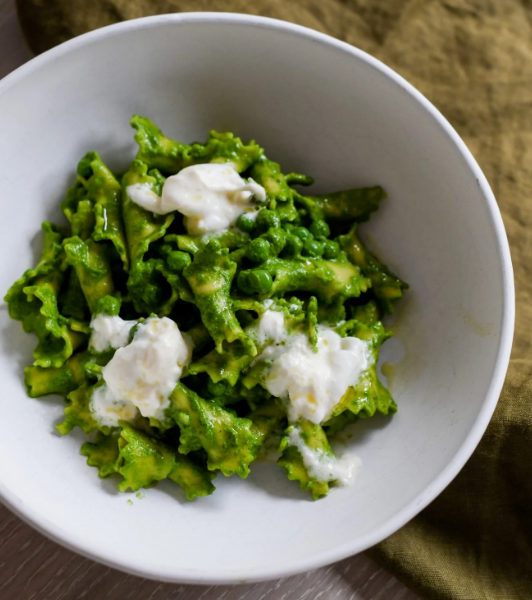
Making fresh campanelle is easier than you think. In this recipe, you’ll discover how to make your own campanelle pasta and make a healthy dish by adding some kale, garlic cloves, and baby peas.
These lemony poppy seed muffins are the perfect way to start the day in Spring. To make these muffins gluten-free, substitute the plain flour with blanched almond meal and gluten-free plain flour.
Pizza can be made healthier by adding some kale, asparagus, zucchini, and a bunch of basil on your toppings. Give it an extra flavour by adding some anchovies, crème fraiche, and mozzarella.
Barramundi Fajitas with Corn Salsa, Guacamole and Chipotle Mayo
Photo supplied
Fajitas is a classic Mexican dish and it’s made even more flavourful and vibrant with the addition of tomatoes, cucumber, and avocado. Make this light and smokey dish for dinner or even at your next party for a dish that’s sure to impress.
Loaded with wonderful spring greens and creamy Danish feta, this easy to make recipe can be a good option when you’re looking for a recipe to make for breakfast or an easy to make dinner.
This bright and fresh tofu dish is the ultimate quick dinner choice. Best served with warm rice, this stir-fry recipe is easy to make and can be divided into four bowls.
Slow Roasted Pork Belly with Fennel and Citrus Salad
Photo supplied
The juicy, slow roasted pork belly pairs perfectly with fennel and citrus salad, which combines oranges, grapefruit, fennel bulb, radicchio, long red chilli, red wine vinegar, and extra virgin olive oil.
A filling meal that’s sure to be a hit with the whole family, this recipe is loaded with green veggie goodness, tasty little chicken bites and golden hued basmati.
This season, Harris Farm Markets also shines the light on Imperfect Picks, which are seasonal ranges of fruits and vegetables that might not look perfect from the outside but are as perfect and full of flavour as ever on the inside.
Every time shoppers buy an Imperfect Pick, they are helping Harris Farm Markets take more from their farmers, they are helping reduce food wastage, and importantly, they are saving up to 50 per cent.
Harris Farm Market in Clayfield is open from 6:00 a.m. to 9:00 p.m. daily. Follow the Facebook page for more updates.
Starting from the Federation Era in the early 20th century, many of Brisbane’s prominent upper-middle-class families chose to build their finest, forever homes in Clayfield. Here’s a closer look at four heritage houses on Norman Parade that have been deemed historically significant to the development of Clayfield, as we know it today.
Bunburra
Charles Henry Day commissioned Eaton and Bates to design this ornate Federation-era house in 1902 when he purchased the land formerly owned by the Pettigrew family.
Mr Day was a wealthy commercial traveller who wanted a villa residence in the Eagle Junction area. He named the house Bunburra.
A few years later, Mr Day sold Bunburra to Katherine Peel and her husband Robert Sydney Frederick Peel. They were active in the organisation running the Clayfield Flower Show.
Photo Credit: National Library of Australia
The family lived in Bunburra until 1917. Since then, the stylish house has had several owners who retained its rare detailing and beautiful stained glass windows through the years.
As of 2021, Bunburra, on 18 Norman Parade, was valued at $1.3 million when it was sold to a new family.
Next door to Bunburra, on 22 Norman Parade, is another Federation-style house built for the family of Thomas Johnston, a contractor, around the same year as its neighbour. Generations of the Johnston family owned this property until the 1950s.
Photo Credit: National Library of Australia
The house was also named Moyola, as mentioned in the socials of the Brisbane Courier in 1913. Today, this house is estimated to be valued at $1.9 to $2.7 million.
Warehouse property manager Josiah Henry Peel had this residence built in 1906 on 26 Norman Parade. He and his wife named this house the Lycullin.
The Peels raised one son and three daughters in Lycullin, which became the scene for many social gatherings, as the Peels were among the prominent members of the Brisbane social set then.
Photo Credit: National Library of Australia
Mr Peel was well-known in the leather and grindery trade, where he was active for over 50 years. He was also one of the founders of the Commercial Travellers Association and a member of the illustrious Tattersalls’ Club. Originally from London, he was a keen gardener and avid motorist.
Lycullin was last sold to new owners in 2020 for $1.290 million.
Kilcreggan
Constructed around 1897, this Federation-style house on 51 Norman Parade, which was also known as Kilcreggan, was owned by David Graham Macfie who was the managing director of the Australian Mines Agency.
Later on, notable personalities like John Leahy and Frank McDonnell called Kilcreggan their home as well.
Mr Leahy was the Speaker of the House from 1907-1902. He also held prominent positions a the Queensland Meat Export Agency Co, the Australian Estates and Mortgage Company, and the Brisbane Chamber of Commerce.
Mr McDonnell founded McDonnell and East, a well-known department store in the CBD. He and his wife lived in Kilcreggan until his death in 1929.
Photo Credit: Google Maps
Today, Kilcreggan is known as The Residence, a retirement home.